Category Archives: North America

Past, Present and Future: California’s Epic Struggle With Water

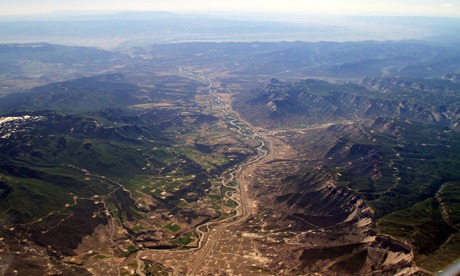
Image courtesy of Ca.gov

Image courtesy of Ca.gov

Alexis C. Madrigal’s new piece in The Atlantic, which he tweeted is his most ambitious yet, is a good read. It has great descriptions of California’s ongoing, larger-than-life efforts to stay hydrated in a place where nature simply won’t cooperate. The article centers on Gov. Jerry Brown’s $25 billion Bay Delta Conservation Plan, which proposes to dig two tunnels under the entire Sacramento-San Joaquin Delta. If built, they’ll be longer than the Chunnel connecting England and France under the English Channel.

Read more:

American Aqueduct: The Great California Water Saga
A $25 billion plan, a small town, and a half-century of wrangling over the most important resource in the biggest state
Alexis C. Madrigal, The Atlantic

Recent related posts:

Serious Water Conservation Requires Layered Approach and Emotional Commitment

California’s State-of-the-State Address: Brown’s Drought Plan in Broad Strokes

Civilization Lost? California’s 500-Year Drought Potential

To the Rescue in California? Solar-Powered Desalination

Leave a comment

Filed under Agriculture, Conflicts, Conservation, Dams and Hydropower, Drought, Environment, Groundwater, Industry, North America, Rivers and Watersheds, Technology, Water Shortage

Restoring Rivers: American Rivers Announces 51 Dam Removals in 2013, Builds New Interactive Map

dam removal

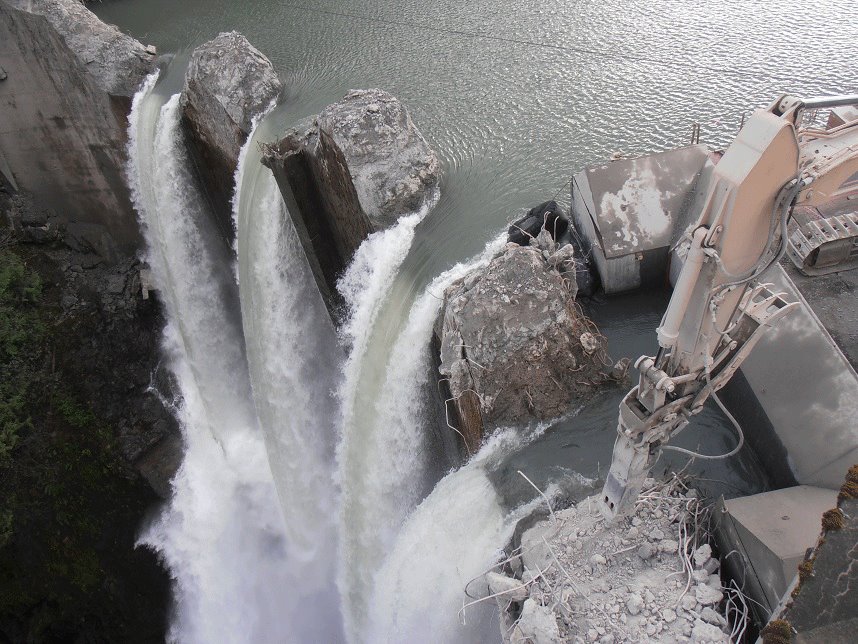
On Wednesday the nonprofit group American Rivers announced its list of outdated or unsafe U.S. dams removed in 2013 to restore rivers, tallying 51 projects undertaken by communities in 18 states working with nonprofit groups and state and federal agencies.

American Rivers says it had a hand in 25 of the 2013 dam removals, but tracks all removals, and is the only organization to do so. According to the group, the top states for dam removal last year were Pennsylvania (12), Oregon (eight), New Jersey (four), and, with three apiece, Maine, Massachusetts, North Carolina and Vermont.  About 1,150 dams have been removed since 1912, with most of those deconstructions occurring in the past 20 years.

Why remove dams? There are tens of thousands of them in the U.S., and quite a few are old, unsafe or no longer serve their intended purpose. As former U.S. Secretary of the Interior Bruce Babbitt once said, “on average, we have constructed one dam every day since the signing of the Declaration of Independence.” Removing them, especially those that no longer do enough for us (e.g., generating adequate amounts of reasonably clean hydropower), can restore river health, clean water, and fish and wildlife, and improve public safety and recreation. See a more complete list of reasons here.

To accompany the 2013 list, American Rivers launched an interactive map that includes all known dam removals in the United States as far back as 1936. The map features the name of the dam and river, location, year the dam was removed, and a description.

“For the first time ever, we have an interactive map that shows every dam removal that has ever happened in the U.S.,” said Devin Dotson, American Rivers’ associate director of communications. “There aren’t many things that have such a big impact on a river as a dam. They block a river, they can hurt clean water, they can hurt fish, they can hurt wildlife. American Rivers has pioneered a science-based approach to the removal of outdated dams.”

Read more from AmericanRivers.org:

51 dams removed to restore rivers in 2013

New interactive map: all known U.S. dam removals since 1936

Why we remove dams

Making hydropower safe for rivers

Leave a comment

Filed under Conservation, Dams and Hydropower, Environment, NGOs, North America, Rivers and Watersheds, Technology, Water Resources

As Fracking Booms, Wastewater Concerns Grow

Image: insurancequotes.org

Image: insurancequotes.org

With hydraulic fracturing for oil and gas continuing to proliferate across the U.S., scientists and environmental activists are raising questions about whether millions of gallons of contaminated drilling fluids could be threatening water supplies and human health.

– Yale Environment 360

Leave a comment

Filed under Fracking, Groundwater, Industry, North America, Pollution, Research, Rivers and Watersheds, Wastewater Treatment, Water Resources

Fracking Compounds Worries Over Water Shortages

Fracking sites in Colorado. Image: Susan Heller/Getty Images

Fracking sites in Colorado. Image: Susan Heller/Getty Images

A new report by the nonprofit group Ceres, which advises on green investment, indicates that 55% of hydraulic fracturing in the United States since 2011 has taken place in drought-stricken areas, such as California, Colorado and Texas.

And 47% of the wells are in regions with high or extremely high water stress. “High” water stress means that between 40% and 80% of a region’s surface and groundwater are already allocated for other uses (residential, agricultural, industrial); “extremely high” water stress means that more than 80% is spoken for.

The report’s findings are significant because fracking uses a lot of water. Each well can require up to 10 million gallons of water in the drilling process, which pumps chemicals and water into shale deposits thousands of feet underground to break up the rock and release natural gas or oil. According to the report, 97 billion gallons of water went into the ground at 39,300 sites between January 2011 and May 2013.

The oil and gas industry points out that its use of water is comparatively small. In many states, fracking draws well under 1% of all water used, according to sources. The industry also says it will increase the amount of recycled water used (from none or next to none in most places to … some, presumably). Finally, there is some evidence from a University of Texas study that fracking reduces water use overall because it decreases reliance on water-intensive coal production, as it pushes utilities to use more natural gas power.

Read more:

Hydraulic Fracturing and Water Stress: Water Demand by the Numbers” – Ceres

Report: Fracking raising water supply worriesUSA Today

California drought sets up fracking face-offSan Francisco Chronicle

Fracking depleting water supplies in America’s driest areas The Guardian

Fracking for natural gas may help us save waterTime

Related posts:

U.S. Shale Map: Could Be a Lot of Fracking Drilling in the Lower 48

Serious Water Conservation Requires Layered Approach and Emotional Commitment

Leave a comment

Filed under Drought, Fracking, Groundwater, Industry, North America, Research

Serious Water Conservation Demands Layered Approach and Emotional Commitment

Image: Vizimac

Image: Vizimac.com

Drought-ridden California is no stranger to water shortages, but it might be able to learn something about making every drop count from an even drier place: Melbourne, Australia.

Threatened by a severe drought, the Melbourne area used 40% less water per person between 2000 and 2010 than it had in the previous decade, contributing more than 200 billion liters per year to supplies,  former state Labor minister John Thwaites recently wrote. Thwaites, currently chairman of the Monash Sustainability Institute, warned against slackening conservation after restrictions were lifted and water-use began to rise.

Thwaites credits a successful “behaviour-change campaign” for the exceptional water-saving that Melbourne sustained for a decade.  “The campaign was backed by rebates on water-saving products, water restrictions and permanent water-saving rules, tiered pricing to reward water-saving, rules requiring major industry to carry out water audits, and a public social marketing campaign,” Thwaites wrote.

All of those layers across the general population and businesses are important, but the “public social marketing” may deserve special mention when it comes to changing behavior. By flooding media with information about the water shortage, Melbourne nurtured an emotional commitment in people to change habits and save water as a normal part of their daily lives. Even a competitive element was added, when water authorities started showing households how much water they used compared with their neighbors. Manipulative? Sure, but it works. As Thwaites wrote, “How many parents had their children criticising them for letting the water run while they brushed their teeth or washed the potatoes?”

Read more:

Melbourne water supplies: Don’t flush successful conservation efforts down the drainSydney Morning Herald

California drought: San Francisco leads state in water conservationSan Francisco Chronicle

100+ ways to conserve water – Water Use It Wisely

35 conservation techniques for agriculture, farming and gardening – Big Picture Agriculture

Related posts:

California’s State-of-the-State Address: Brown’s Drought Plan in Broad Strokes

Civilization Lost? California’s 500-Year Drought Potential

To the Rescue in California? Solar-Powered Desalination

Leave a comment

Filed under Climate Change, Conservation, Drought, Environment, North America, Oceania, Sustainability, Water Shortage

Over-Salted: The Trouble(s) With Desalination

Image: Sierra Club, Angeles Chapter

Image: Sierra Club, Angeles Chapter

It’s tempting to see desalination as an eventual cure-all for parched places like California — something that is expensive to implement and run because of energy costs, but worth prioritizing someday. Someday, that is, when there is no other way to get enough freshwater. Many countries have turned to it.  Unfortunately, cost is not the only reason to put off desalination projects. Their byproducts, or waste, are bad for the environment and difficult to deal with safely. And in California, critics of seawater desalination would add that far more should be done through conservation before turning to drastic measures.

I recently wrote about solar-powered desalination as an alternative to traditional methods that might help California with its record-breaking drought, focusing on WaterFX and its solar distillation of agricultural run-off water for re-use. On Tuesday, The Guardian‘s Oliver Balch picked up on the story in some depth, referring to renewable desalination projects all over the world, but focusing on WaterFX. That prompted a thoughtful article by environmental journalist Chris Clarke for Southern California’s KCET.org. He asked an obvious and very important question: What about all the salt and other stuff we take out of the water?

At the end of any kind of desalination process, you get leftover piles of salt and buckets of super-salty brine. (Use any measurement metaphor you like, appropriate to scale: piles and buckets; hills and lakes; mountains and oceans.) You get a little freshwater and a lot of leftover crap, some potentially useful and some not, and there’s only so much you can do with it. With WaterFX’s solar distillation, you get brine laced with chemicals and solids from the soil, from fertilizers, motor oil and other sources. The company says it can sell the byproducts, but there’s room for skepticism (and leaky landfills standing by). With seawater, desalination projects tend to filter brine back into the ocean, where it dissolves over time. But brine waste, heavier than seawater, can smother sea life on the ocean floor. And, looking ahead, if huge coastal desalination projects continue to spring up all over the world, how much additional salinity can sea life tolerate? Even in the oceans, a little too much salt can kill.

One thing is relatively clear: Powering desalination with renewable energy should bring down long-term energy costs while providing freshwater. But questions and problems remain. In addition to pollution worries, the timing of when to make the big investment can be tricky. As Clarke points out, a large desalination plant opened in Santa Barbara, Calif., in 1992 because of a drought. But the drought ended, and the plant just sat there because it was too expensive to run in the absence of a crippling water shortage. After its test runs, it never produced a drop of potable water. Now, the largest  desalination plant in the western hemisphere is slated for 2016 completion in Carlsbad, near San Diego, at a cost of $1 billion.

Read more:

UPDATE: Desalination could help California — but only if it’s done right – Los Angeles Times

UPDATE: California drought prompts first-ever “zero water allocation” – Los Angeles Times

In talk of solar desalination, there’s a salty elephant in the room – KCET.org

Is solar-powered desalination the answer to water independence in California?The Guardian

California identifies 17 communities that could run dry within 100 days – CA.org

Carlsbad desalination plant construction on track to meet 2016 goal – KPBS San Diego

Related posts:

California’s State-of-the-State Address: Brown’s Drought Plan in Broad Strokes

Civilization Lost? California’s 500-Year Drought Potential

To the Rescue in California? Solar-Powered Desalination
1 Comment

Filed under Agriculture, Conservation, Desalination, Drought, Environment, Industry, North America, Oceans, Pollution, Technology, Wastewater Treatment, Water Resources, Water Shortage

Calif. State of the State Address: Brown’s Drought Plan in Broad Strokes

Calif. Gov. Brown delivers 2014 State of the State Address. Photo Credit: Justin Short, Office of the Governor.

Calif. Gov. Brown delivers 2014 State of the State Address. Photo Credit: Justin Short, Office of the Governor.

Yesterday, the same day I wrote about California’s dire 3-year drought, California Gov. Edmund G. Brown Jr. laid out the state’s plan regarding the water shortage in his annual State of the State address to the California legislature. It’s not the governor’s job to provide exhaustive detail here, and he doesn’t. The drought got about 15 of the speech’s 130 lines.

Here’s the part of the address about the drought:

Among all our uncertainties, weather is one of the most basic. We can’t control it. We can only live with it, and now we have to live with a very serious drought of uncertain duration. 

Right now, it is imperative that we do everything possible to mitigate the effects of the drought. I have convened an Interagency Drought Task Force and declared a State of Emergency. We need everyone in every part of the state to conserve water. We need regulators to rebalance water rules and enable voluntary transfers of water and we must prepare for forest fires. As the State Water Action Plan lays out, water recycling, expanded storage and serious groundwater management must all be part of the mix. So too must be investments in safe drinking water, particularly in disadvantaged communities. We also need wetlands and watershed restoration and further progress on the Bay Delta Conservation Plan.

It is a tall order.

But it is what we must do to get through this drought and prepare for the next.

We do not know how much our current problem derives from the build-up of heat-trapping gasses, but we can take this drought as a stark warning of things to come. The United Nations Panel on Climate Change says – with 95 percent confidence – that human beings are changing our climate. This means more droughts and more extreme weather events, and, in California, more forest fires and less snow pack.

UPDATE: California drought prompts first-ever “zero water allocation” – Los Angeles Times

Related Posts:

Civilization Lost? California’s 500-Year Drought Potential (Jan. 22, 2014)

Leave a comment

Filed under Climate Change, Conservation, Drought, Environment, Events, North America, Water Resources, Water Shortage

Civilization Lost? California’s 500-Year Drought Potential

Image: NOAA

Image: NOAA

As a California resident for 18 years after college, I got to know dry weather pretty well. Right from the start, having arrived in the San Francisco Bay Area in the middle of the 1987  – 1992 drought, I came to see cloudless skies, brown grass and the occasional dryness-induced nosebleed as normal — so much so that the the incessant winter rains that returned years later seemed, briefly, to be freakish.

Now the state is in an even worse dry period — 2013 was the driest year since record-keeping began in the 1840s — and predictable doom-saying has ensued. It’s pretty hard to resist. After all, we know from the geological record that droughts in the area hundreds and thousands of years ago sometimes lasted decades, or even a century. Droughts of that magnitude have ended civilizations. See the Anasazi, wiped out in the Southwest about 800 years ago.

“Driest year since the 1840s” doesn’t sound good, but the reality is, indeed, probably worse. UC Berkeley paleoclimatologist B. Lynn Graham says old tree rings indicate the area hasn’t been so desiccated since 1580, 434 years ago. She points out that the past 150 years of modern development have been comparatively wetter years than some previous, longer, drier, and, arguably, “normal” periods, as noted above. Those long, dry periods could return.

An interesting characteristic of the drought is the proximate cause pointed out by meteorologists: a ridge of high pressure off the coast is “feeding off itself,” refusing to move or dissipate as it blocks wet weather from reaching land.  The timing is especially bad because California needs winter storms to replace its freshwater, in the form of rains and especially snow melt from the mountains. Sounds like an effect of climate change, something that’s easy to believe but hard to prove.

In addition to Herculean conservation efforts, what could be next for California if the drought persists? Greater Los Angeles and the San Francisco Bay Area are already projected to run out of water by 2050. Perhaps the state will pursue expensive seawater desalination projects on a massive scale, follow China’s lead on sea ice desalination, or go after fresh and brackish water recently found to be in aquifers under oceans.

Read more:

UPDATE: California drought prompts first-ever “zero water allocation” – Los Angeles Times

Why California’s water woes could be just beginning – University of California, Berkeley

California drought: Scientists puzzled by persistence of weather-blocking “ridge” – Christian Science Monitor

The worst drought in the history of California is happening right now – Right Side News

California drought: Water officials look to rules of the ’70s – SFGate

Gov. Brown declares California drought emergencySan Jose Mercury News

Leave a comment

Filed under Climate Change, Conservation, Desalination, Drought, North America, Sustainability, Water Shortage

Top 5 Non-Lethal Uses for Drones

Image: Flying Eye

Image: Flying Eye

Happiness is not a police state, and unmanned aerial vehicles aren’t just for the war machine anymore. Though many of us associate drones with bomb strikes and government surveillance, their civilian use is growing more widespread and attracting massive investment. It’s going to go far beyond recent headline grabbers (e.g., Domino’s pizza-delivery tests and Amazon.com CEO Jeff Bezos saying on “60 Minutes” that deliveries by drone will be off the ground in 2015, depending on FAA approval). Essentially, anything that calls for a bird’s-eye view, aerial photgraphy, or lightweight deliveries can benefit from drone service. In no particular order, here are five favorites, already underway:

Monitoring and protecting wildlife.  Some early indicators suggest drones are better at spotting wildlife than people in planes and helicopters are, while also reducing costs and risks to human life. Researchers have found success deploying drones to survey dugongs, a vegetarian marine mammal related to the manatee, in Shark Bay, on the western Australia coast. The U.S. Geological Survey uses drones to count sandhill crane populations. The devices are also used to track endangered Sumatran orangutans.

Delivering medicine. The Bill and Melinda Gates Foundation has awarded a $100,000 grant to George Barbastathis and collaborators at the Harvard-MIT Division of Health Sciences and Technology in the U.S. They’re working on unmanned aerial vehicles that health care workers can deploy via cell phones to swiftly deliver vaccines and the like.

3-D mapping for everyone. Using a lightweight drone and powerful new software, almost anyone will soon be able to create precise 3-D maps for any number of uses, such as crop management, facilities monitoring and disaster relief operations.  Watch Pix4D co-founder Olivier Kung’s TEDx talk on the subject.

Search-and-rescue. The Royal Canadian Mounted Police reported what they believed to be the first use of a drone to rescue an accident victim. After a late-night car accident in remote Saskatchewan in May 2013, an injured and disoriented man called police but couldn’t report his location. Worse, he wandered far from the crash site.  A helicopter search failed to find the man, even with night-vision gear, but an unmanned drone with an infrared camera did the job. Without it, he would not have survived the night.

Hurricane tracking. Improvements in drone technology have increased the aircraft’s range and flying time, making them invaluable for gathering weather data. An airplane can’t safely stay inside a hurricane for 30 hours, as some drones can.  NASA and Northrop Grumman have teamed up on a $30 million project to monitor storms as they evolve. A University of Florida project is looking at doing similar work with swarms of tiny drones.

Leave a comment

Filed under Agriculture, Conservation, Environment, Industry, Natural Disasters, North America, Oceans, Research, Technology

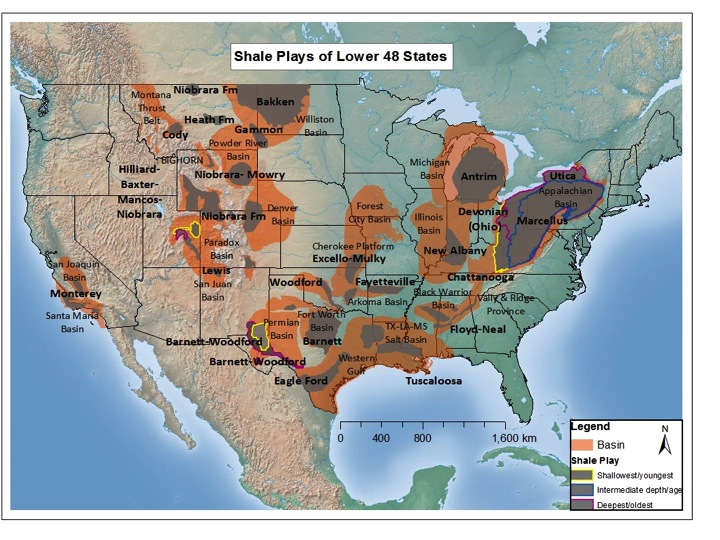
U.S. Shale Map: Could Be a Lot of Fracking Drilling in the Lower 48

Image: Duke University

Image: Duke University

See the website for the Duke University study on shale gas and fracking, Avner Vengosh research group, Duke Nicholas School of the Environment.

OTHER RELATED LINKS AND POSTS:

Duke study suggests cutting fracking waste’s radioactivity with acid drainage from mines – The Associated Press (Jan. 13, 2014)

Duke fracking tests reveal dangers driller’s study missed in Texas – Bloomberg (Jan.  10, 2014)

Drilling Down on Fracking: Latest News Plus Background (Jan. 6, 2014)

Fracking Across the Pond: In the UK (Jan 8, 2014)

Leave a comment

January 14, 2014 · 10:26 am