
Image: treehugger.com
Related pages: Water Facts, Water Resources
Image: treehugger.com
Related pages: Water Facts, Water Resources
Filed under Conservation, North America, Research, Water Resources, Water Shortage

Image: thaibiodiversity.org
Playing with maps can be fun — except when it’s totally depressing.
In adding China Water Risk, an interesting information source, to this blog’s Water Resources page, I was reminded of another one I had already added: World Resources Institute (WRI), which provides a home for Aqueduct’s mapping surveys of water-stressed places. China Water Risk provides a version of WRI’s helpful breakdown of the data and list of 36 most water-stressed countries. So, rather than jumping straight into the mapping tool’s various menus to generate visualizations of data, you can get a bit of an overview of how the tool works and some of its findings.
Aqueduct’s mapping tool, the Aqueduct Water Risk Atlas, uses 12 indicators to value amounts of water stress, and assigns each country a score of up to 5 points, the high end of the scale for potential water stress. Sixteen countries representing a handful of world regions, such as the Caribbean, the Middle East, and parts of Africa and Asia, achieve a perfect(ly dire) score of 5.0. All 36 countries on the list of the most at risk of water stress rank 4.01 or higher, suffering “extremely high risk.” See the list.
Filed under Africa, Asia, Caribbean, Conflicts, Middle East, Research, Sustainability, Water Resources, Water Shortage
Image: cawater-info.net
The prediction that water will outstrip oil — and every other scarce natural resource — as a factor in global conflict has been around for a long time. After all, without water, everybody and everything dies. There is no substitute for it. Among water-stressed regions, where is conflict likely to strike, and when? In many places, it’s already happening.
Conflict is widespread and ongoing because it can take many forms besides all-out war. In some areas, competition over water may be at the root of tensions between warring factions, though not the only cause. In certain conflicts, water resources may be military or terrorist targets, either to capture or to destroy as a way of hurting the enemy. Elsewhere, protests over water shortages resulting from perceived mismanagement can erupt in violence. The Pacific Institute studies these issues; the conflict chronology at the link below is especially interesting because it shows the whole gamut of water-related struggles.
A useful backgrounder on water-related conflict can be found in Suzanne Goldenberg’s recent piece for The Guardian, also linked below. It identifies six “regions at risk,” due to extreme drought and/or tension over shared resources: California, Brazil, Middle East (Iran, United Arab Emirates, Jordan), North Africa (Egypt and Ethiopia), South Asia (eastern Pakistan, northern India), and China. Stephen Leahy’s IPS article and Giulio Boccaletti’s op-ed for The Nature Conservancy further fill in the picture and scope of global water (in)security.
Read more:
Why global water shortages pose threat of terror and war – The Guardian
In an increasingly unpredictable world, we must secure nature to secure our water – The Nature Conservancy
Water crisis hitting food, energy — and everything else – IPS
Pacific Institute: water and conflict
Pacific Institute: water conflict chronology
Related posts:
Past, Present and Future: California’s Epic Struggle With Water
Filed under Africa, Asia, Conflicts, Drought, Middle East, North America, Research, South America, Water Shortage
Image: piazzaffari.info
Last month the launch of the Green Growth Knowledge Platform (GGKP) coincided with the opening of the organization’s office at the International Environment House in Geneva, Switzerland, on Jan. 22. It was a stellar opportunity for me to get out of the house, but I missed it. So I doubled back and talked by phone with the group about its efforts.
What’s the point of GGKP? As Benjamin Simmons, the organization’s head. puts it in this succinct-yet-comprehensive overview: “Our aim is straightforward: to give policy makers, academics, experts and other professionals easy access to the most relevant green growth studies, policy analysis, guidance and data.”
It’s all about putting the best information about sustainable development and ways of reaching the goal of a “green economy” in front of the right people. The link in the previous sentence goes to the UN Environment Programme (UNEP), which boils down the definition of green economy to its essence: It’s low carbon, resource efficient and socially inclusive.
“The first part of our mission is about catalyzing research in and around green growth,” said Amanda McKee, GGKP’s communications and outreach officer, based in Washington, D.C. “The second part of our mission is to make all the research acceptable to policy makers and practitioners.”
The data in the platform covers a lot of ground. The resource library contains about 600 publications organized by sector (e.g., water) and cross-cutting theme (e.g., gender), McKee said, adding that data is also organized geographically, representing 193 countries (see the Green Growth Map).
There’s also a collaborative element aimed at filling green-growth knowledge gaps. Currently, committees are looking at four topics: trade and competitiveness, technology and innovation, measurement and indicators, and fiscal instruments. “If we’re able to generate results from this, we’ll branch out into other topics and launch new committees,” McKee said.
And how will GGKP know if it’s succeeding in its overall mission?
“We’re in the process of developing indicators for measuring success,” McKee said. “In terms of the knowledge-generation aspect, I think the way we’ll measure success is how much of this research is ultimately picked up by these communities. On the knowledge-management side, a sign of success would be how many policy makers or government officials are making use of resources to put in place green-growth strategies or policies.”
The GGKP was established by the Global Green Growth Institute (GGGI), the Organisation for Economic Co-operation and Development (OECD), the United Nations Environment Programme (UNEP), and the World Bank, where it was initially “incubated,” McKee said. Those steering organizations provide in-kind contributions and part-time staffing to GGKP, while strategic funding comes from the government of Switzerland, which is providing 1.6 million CHF over three years.
GGKP’s main event is its annual conference; the next one, organized by UNEP, will take place in February 2015. The group sometimes stages side-events at major conferences, like the “open-thinking event on the expansion of green-growth knowledge” planned for UNEP’s inaugural Partnership for Action on Green Economy (PAGE) conference coming up in Dubai, UAE, March 4-5, McKee said.
Filed under Climate Change, Conservation, Environment, Europe, Events, Human rights, NGOs, Pollution, Research, Science, Technology, United Nations, Water Resources

Image: insurancequotes.org
– Yale Environment 360

Image courtesy of WaterLex
One of the benefits of living in Geneva, Switzerland, is that I have access to the United Nations and international organizations that work with it. WaterLex, for example, is an international NGO that partners with UN Water. It takes an interesting, forward-looking, “lawyerly” approach to working on issues related to freshwater scarcity. The group, with a staff of seven based here, helps water-governance stakeholders in various countries establish policies and standards that comply with the human right to water and sanitation (HRWS). To do its work, the staff consults with more than 100 international experts in water management, development and law.
Many water NGOs work on access to water, helping people in water-stressed communities survive by delivering clean water, digging wells, installing pumps, and so forth. WaterLex attacks the problem close to its root and in a way that helps enable water security for future generations: It trains lawmakers and others with influence over water resources in a community, or a country, on how to implement new legal frameworks in which the human right to water is central.
WaterLex Executive Director Jean-Benoit Charrin co-founded the organization in 2010, the same year the human right to water and sanitation became fully recognized. I spoke with him on Tuesday at the WaterLex offices down the street from the Palace of Nations (UN). The rest of the staff, a mix of lawyers and operations experts, were away on missions. Although I would have liked to meet them, I’m glad they were off doing their work.
“There are four things we never want to hear people say again,” Charrin said. “That they didn’t know there was a problem. That they know there is a problem, but they don’t know how to deal with it. That they know there is a problem and how to deal with it, but they don’t know how to get the money. And finally, that they know there is a problem but they don’t care.” He paralleled the four statements succinctly with four WaterLex work areas: providing assistance with information, capacity-building, budgeting, and accountability. Learn more about the group’s work below.
WaterLex tools (naturally, these are also on the Water Resources page):
WaterLex Legal Database on the Human Right to Water and Sanitation
WaterLex Toolkit: Integrating the Human Right to Water and Sanitation in Development Practice
Examples of WaterLex activities:
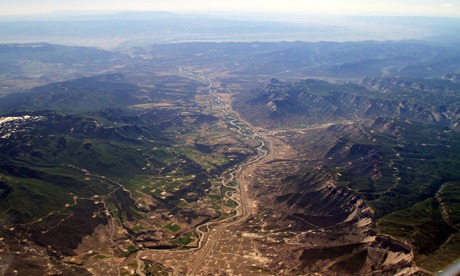
Fracking sites in Colorado. Image: Susan Heller/Getty Images
A new report by the nonprofit group Ceres, which advises on green investment, indicates that 55% of hydraulic fracturing in the United States since 2011 has taken place in drought-stricken areas, such as California, Colorado and Texas.
And 47% of the wells are in regions with high or extremely high water stress. “High” water stress means that between 40% and 80% of a region’s surface and groundwater are already allocated for other uses (residential, agricultural, industrial); “extremely high” water stress means that more than 80% is spoken for.
The report’s findings are significant because fracking uses a lot of water. Each well can require up to 10 million gallons of water in the drilling process, which pumps chemicals and water into shale deposits thousands of feet underground to break up the rock and release natural gas or oil. According to the report, 97 billion gallons of water went into the ground at 39,300 sites between January 2011 and May 2013.
The oil and gas industry points out that its use of water is comparatively small. In many states, fracking draws well under 1% of all water used, according to sources. The industry also says it will increase the amount of recycled water used (from none or next to none in most places to … some, presumably). Finally, there is some evidence from a University of Texas study that fracking reduces water use overall because it decreases reliance on water-intensive coal production, as it pushes utilities to use more natural gas power.
Read more:
“Hydraulic Fracturing and Water Stress: Water Demand by the Numbers” – Ceres
Report: Fracking raising water supply worries – USA Today
California drought sets up fracking face-off – San Francisco Chronicle
Fracking depleting water supplies in America’s driest areas – The Guardian
Fracking for natural gas may help us save water – Time
Related posts:
U.S. Shale Map: Could Be a Lot of Fracking Drilling in the Lower 48
Serious Water Conservation Requires Layered Approach and Emotional Commitment
Filed under Drought, Fracking, Groundwater, Industry, North America, Research

Image: European Commission
In Brussels on Thursday, the European Commission unveiled 11 projects slated to receive €50 million to support their innovative responses to “water-related challenges” (to put a lot of different fish in one tank, so to speak).
The projects involve 179 partners representing research organizations and private companies across 19 European countries. There’s a lot of variety in the types of work, as well. Three examples: smarter management of water distribution networks; biotech treatment of heavy metal pollution in wastewater; and new “aquaponic” systems combining aquaculture and hydroponics in agricultural production. You can see the project names and acronyms listed in the tags accompanying this post, and more description of each project can be found here.
The funds come from the 2013 “Environment call” for projects of the European Union’s s Seventh Framework Programme for Research and Technological Development (FP7). This brings total FP7 funding for water-related projects, 2007 – 2013, to more than €1 billion. A new funding initiative rolled out this month, the Horizon 2020 program, is expected to bring another €165 million to water projects in its first round of calls.
Read more:
UPDATE: Event presentations now uploaded
European Commission press release

Image: Flying Eye
Happiness is not a police state, and unmanned aerial vehicles aren’t just for the war machine anymore. Though many of us associate drones with bomb strikes and government surveillance, their civilian use is growing more widespread and attracting massive investment. It’s going to go far beyond recent headline grabbers (e.g., Domino’s pizza-delivery tests and Amazon.com CEO Jeff Bezos saying on “60 Minutes” that deliveries by drone will be off the ground in 2015, depending on FAA approval). Essentially, anything that calls for a bird’s-eye view, aerial photgraphy, or lightweight deliveries can benefit from drone service. In no particular order, here are five favorites, already underway:
Monitoring and protecting wildlife. Some early indicators suggest drones are better at spotting wildlife than people in planes and helicopters are, while also reducing costs and risks to human life. Researchers have found success deploying drones to survey dugongs, a vegetarian marine mammal related to the manatee, in Shark Bay, on the western Australia coast. The U.S. Geological Survey uses drones to count sandhill crane populations. The devices are also used to track endangered Sumatran orangutans.
Delivering medicine. The Bill and Melinda Gates Foundation has awarded a $100,000 grant to George Barbastathis and collaborators at the Harvard-MIT Division of Health Sciences and Technology in the U.S. They’re working on unmanned aerial vehicles that health care workers can deploy via cell phones to swiftly deliver vaccines and the like.
3-D mapping for everyone. Using a lightweight drone and powerful new software, almost anyone will soon be able to create precise 3-D maps for any number of uses, such as crop management, facilities monitoring and disaster relief operations. Watch Pix4D co-founder Olivier Kung’s TEDx talk on the subject.
Search-and-rescue. The Royal Canadian Mounted Police reported what they believed to be the first use of a drone to rescue an accident victim. After a late-night car accident in remote Saskatchewan in May 2013, an injured and disoriented man called police but couldn’t report his location. Worse, he wandered far from the crash site. A helicopter search failed to find the man, even with night-vision gear, but an unmanned drone with an infrared camera did the job. Without it, he would not have survived the night.
Hurricane tracking. Improvements in drone technology have increased the aircraft’s range and flying time, making them invaluable for gathering weather data. An airplane can’t safely stay inside a hurricane for 30 hours, as some drones can. NASA and Northrop Grumman have teamed up on a $30 million project to monitor storms as they evolve. A University of Florida project is looking at doing similar work with swarms of tiny drones.
Filed under Agriculture, Conservation, Environment, Industry, Natural Disasters, North America, Oceans, Research, Technology
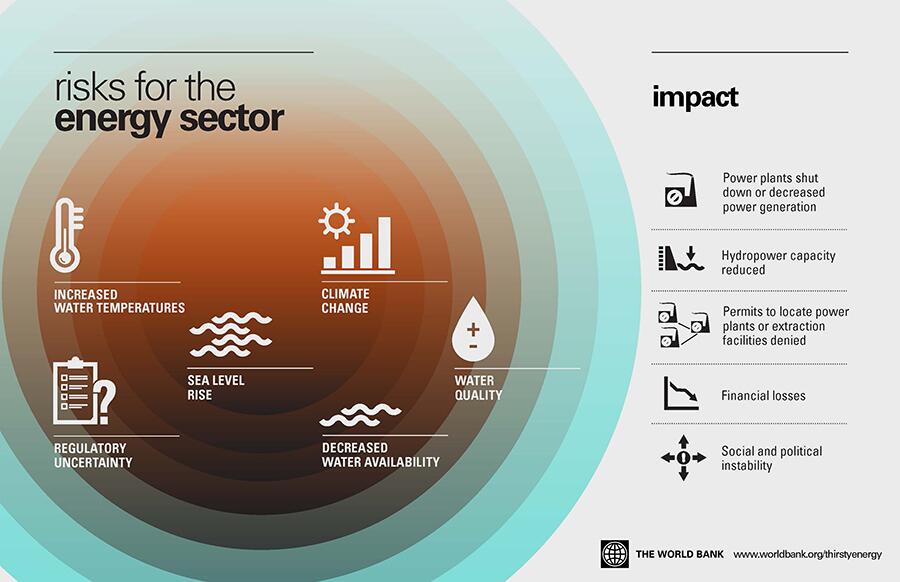
Image: World Bank Water
The World Bank has announced the launch of its “Thirsty Energy” initiative, aimed at helping governments tackle growing water-energy challenges, at the 7th annual World Future Energy Summit (WFES) and the 2nd annual International Water Summit (IWS). The two meetings are running concurrently, Jan. 20 – Jan. 22, at the Abu Dhabi National Exhibition Centre in the United Arab Emirates.
It takes a lot of water to generate power through various processes, and it takes a lot of power to extract, treat and deliver water. Yet, according to the World Bank, energy planning and development decisions are often made without regard to current and future water shortages. Its plan is to offer proactive, cross-sector advice on energy and water resource management planning, tailored according to a given country’s resources, modeling experience, and political and institutional realities.
Why go to all that trouble? Because near-future projections paint a disturbing picture. Today more than 780 million people don’t have enough access to potable drinking water, and about 1.3 billion lack electricity, according to estimates. In a world with a fixed and finite amount of freshwater but a surging population, global energy consumption is expected to swell 50% by 2035, while the energy sector’s use of water may increase by 85%. That means worsening water shortages, and, as noted in a previous post, climate change will make the situation even more dire in certain areas.
UPDATE: Thirsty energy: the conflict between demands for water and energy – The Guardian
More from WFES and IWS:
World Bank launches “Thirsty Energy” initiative – The World Bank / WFES
Will water contrain our energy future? (Thirsty Energy initiative, with extensive info graphics) – The World Bank
Four ways water shortages are harming energy production – The Water Blog (blogs.worldbank.org)
Denmark and Abu Dhabi sign clean-energy deal – The National
Related posts:
On tap Monday: Annual UN Water conference in Spain (Jan. 12, 2014)
Study: Freshwater shortage will double climate change’s impact on agriculture (Dec. 17, 2013)


 At the Waterline