

Image: insurancequotes.org
– Yale Environment 360
Image: insurancequotes.org
– Yale Environment 360

Image: IDA
Filed under Desalination, Oceans, Technology, Water Resources, Water Shortage

Image courtesy of WaterLex
One of the benefits of living in Geneva, Switzerland, is that I have access to the United Nations and international organizations that work with it. WaterLex, for example, is an international NGO that partners with UN Water. It takes an interesting, forward-looking, “lawyerly” approach to working on issues related to freshwater scarcity. The group, with a staff of seven based here, helps water-governance stakeholders in various countries establish policies and standards that comply with the human right to water and sanitation (HRWS). To do its work, the staff consults with more than 100 international experts in water management, development and law.
Many water NGOs work on access to water, helping people in water-stressed communities survive by delivering clean water, digging wells, installing pumps, and so forth. WaterLex attacks the problem close to its root and in a way that helps enable water security for future generations: It trains lawmakers and others with influence over water resources in a community, or a country, on how to implement new legal frameworks in which the human right to water is central.
WaterLex Executive Director Jean-Benoit Charrin co-founded the organization in 2010, the same year the human right to water and sanitation became fully recognized. I spoke with him on Tuesday at the WaterLex offices down the street from the Palace of Nations (UN). The rest of the staff, a mix of lawyers and operations experts, were away on missions. Although I would have liked to meet them, I’m glad they were off doing their work.
“There are four things we never want to hear people say again,” Charrin said. “That they didn’t know there was a problem. That they know there is a problem, but they don’t know how to deal with it. That they know there is a problem and how to deal with it, but they don’t know how to get the money. And finally, that they know there is a problem but they don’t care.” He paralleled the four statements succinctly with four WaterLex work areas: providing assistance with information, capacity-building, budgeting, and accountability. Learn more about the group’s work below.
WaterLex tools (naturally, these are also on the Water Resources page):
WaterLex Legal Database on the Human Right to Water and Sanitation
WaterLex Toolkit: Integrating the Human Right to Water and Sanitation in Development Practice
Examples of WaterLex activities:
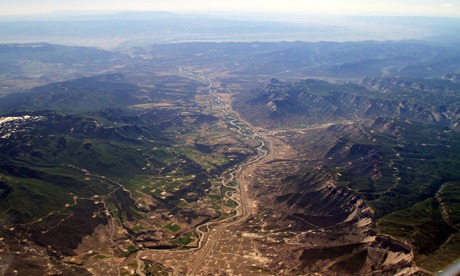
Fracking sites in Colorado. Image: Susan Heller/Getty Images
A new report by the nonprofit group Ceres, which advises on green investment, indicates that 55% of hydraulic fracturing in the United States since 2011 has taken place in drought-stricken areas, such as California, Colorado and Texas.
And 47% of the wells are in regions with high or extremely high water stress. “High” water stress means that between 40% and 80% of a region’s surface and groundwater are already allocated for other uses (residential, agricultural, industrial); “extremely high” water stress means that more than 80% is spoken for.
The report’s findings are significant because fracking uses a lot of water. Each well can require up to 10 million gallons of water in the drilling process, which pumps chemicals and water into shale deposits thousands of feet underground to break up the rock and release natural gas or oil. According to the report, 97 billion gallons of water went into the ground at 39,300 sites between January 2011 and May 2013.
The oil and gas industry points out that its use of water is comparatively small. In many states, fracking draws well under 1% of all water used, according to sources. The industry also says it will increase the amount of recycled water used (from none or next to none in most places to … some, presumably). Finally, there is some evidence from a University of Texas study that fracking reduces water use overall because it decreases reliance on water-intensive coal production, as it pushes utilities to use more natural gas power.
Read more:
“Hydraulic Fracturing and Water Stress: Water Demand by the Numbers” – Ceres
Report: Fracking raising water supply worries – USA Today
California drought sets up fracking face-off – San Francisco Chronicle
Fracking depleting water supplies in America’s driest areas – The Guardian
Fracking for natural gas may help us save water – Time
Related posts:
U.S. Shale Map: Could Be a Lot of Fracking Drilling in the Lower 48
Serious Water Conservation Requires Layered Approach and Emotional Commitment
Filed under Drought, Fracking, Groundwater, Industry, North America, Research
Image: Vizimac.com
Drought-ridden California is no stranger to water shortages, but it might be able to learn something about making every drop count from an even drier place: Melbourne, Australia.
Threatened by a severe drought, the Melbourne area used 40% less water per person between 2000 and 2010 than it had in the previous decade, contributing more than 200 billion liters per year to supplies, former state Labor minister John Thwaites recently wrote. Thwaites, currently chairman of the Monash Sustainability Institute, warned against slackening conservation after restrictions were lifted and water-use began to rise.
Thwaites credits a successful “behaviour-change campaign” for the exceptional water-saving that Melbourne sustained for a decade. “The campaign was backed by rebates on water-saving products, water restrictions and permanent water-saving rules, tiered pricing to reward water-saving, rules requiring major industry to carry out water audits, and a public social marketing campaign,” Thwaites wrote.
All of those layers across the general population and businesses are important, but the “public social marketing” may deserve special mention when it comes to changing behavior. By flooding media with information about the water shortage, Melbourne nurtured an emotional commitment in people to change habits and save water as a normal part of their daily lives. Even a competitive element was added, when water authorities started showing households how much water they used compared with their neighbors. Manipulative? Sure, but it works. As Thwaites wrote, “How many parents had their children criticising them for letting the water run while they brushed their teeth or washed the potatoes?”
Read more:
Melbourne water supplies: Don’t flush successful conservation efforts down the drain – Sydney Morning Herald
California drought: San Francisco leads state in water conservation – San Francisco Chronicle
100+ ways to conserve water – Water Use It Wisely
35 conservation techniques for agriculture, farming and gardening – Big Picture Agriculture
Related posts:
California’s State-of-the-State Address: Brown’s Drought Plan in Broad Strokes
Filed under Climate Change, Conservation, Drought, Environment, North America, Oceania, Sustainability, Water Shortage

Image: Sierra Club, Angeles Chapter
It’s tempting to see desalination as an eventual cure-all for parched places like California — something that is expensive to implement and run because of energy costs, but worth prioritizing someday. Someday, that is, when there is no other way to get enough freshwater. Many countries have turned to it. Unfortunately, cost is not the only reason to put off desalination projects. Their byproducts, or waste, are bad for the environment and difficult to deal with safely. And in California, critics of seawater desalination would add that far more should be done through conservation before turning to drastic measures.
I recently wrote about solar-powered desalination as an alternative to traditional methods that might help California with its record-breaking drought, focusing on WaterFX and its solar distillation of agricultural run-off water for re-use. On Tuesday, The Guardian‘s Oliver Balch picked up on the story in some depth, referring to renewable desalination projects all over the world, but focusing on WaterFX. That prompted a thoughtful article by environmental journalist Chris Clarke for Southern California’s KCET.org. He asked an obvious and very important question: What about all the salt and other stuff we take out of the water?
At the end of any kind of desalination process, you get leftover piles of salt and buckets of super-salty brine. (Use any measurement metaphor you like, appropriate to scale: piles and buckets; hills and lakes; mountains and oceans.) You get a little freshwater and a lot of leftover crap, some potentially useful and some not, and there’s only so much you can do with it. With WaterFX’s solar distillation, you get brine laced with chemicals and solids from the soil, from fertilizers, motor oil and other sources. The company says it can sell the byproducts, but there’s room for skepticism (and leaky landfills standing by). With seawater, desalination projects tend to filter brine back into the ocean, where it dissolves over time. But brine waste, heavier than seawater, can smother sea life on the ocean floor. And, looking ahead, if huge coastal desalination projects continue to spring up all over the world, how much additional salinity can sea life tolerate? Even in the oceans, a little too much salt can kill.
One thing is relatively clear: Powering desalination with renewable energy should bring down long-term energy costs while providing freshwater. But questions and problems remain. In addition to pollution worries, the timing of when to make the big investment can be tricky. As Clarke points out, a large desalination plant opened in Santa Barbara, Calif., in 1992 because of a drought. But the drought ended, and the plant just sat there because it was too expensive to run in the absence of a crippling water shortage. After its test runs, it never produced a drop of potable water. Now, the largest desalination plant in the western hemisphere is slated for 2016 completion in Carlsbad, near San Diego, at a cost of $1 billion.
Read more:
UPDATE: Desalination could help California — but only if it’s done right – Los Angeles Times
UPDATE: California drought prompts first-ever “zero water allocation” – Los Angeles Times
In talk of solar desalination, there’s a salty elephant in the room – KCET.org
Is solar-powered desalination the answer to water independence in California? – The Guardian
California identifies 17 communities that could run dry within 100 days – CA.org
Carlsbad desalination plant construction on track to meet 2016 goal – KPBS San Diego
Related posts:
California’s State-of-the-State Address: Brown’s Drought Plan in Broad Strokes

Image: European Commission
In Brussels on Thursday, the European Commission unveiled 11 projects slated to receive €50 million to support their innovative responses to “water-related challenges” (to put a lot of different fish in one tank, so to speak).
The projects involve 179 partners representing research organizations and private companies across 19 European countries. There’s a lot of variety in the types of work, as well. Three examples: smarter management of water distribution networks; biotech treatment of heavy metal pollution in wastewater; and new “aquaponic” systems combining aquaculture and hydroponics in agricultural production. You can see the project names and acronyms listed in the tags accompanying this post, and more description of each project can be found here.
The funds come from the 2013 “Environment call” for projects of the European Union’s s Seventh Framework Programme for Research and Technological Development (FP7). This brings total FP7 funding for water-related projects, 2007 – 2013, to more than €1 billion. A new funding initiative rolled out this month, the Horizon 2020 program, is expected to bring another €165 million to water projects in its first round of calls.
Read more:
UPDATE: Event presentations now uploaded
European Commission press release

Image: Fabrice Coffrini/AFP/Getty
A chill runs through me whenever I hear a sample of the gaffe from Mitt Romney’s 2011 presidential campaign speech in Iowa: “Corporations are people, my friend.” He was responding to a heckler. What he said was accurate in the eyes of the law in the United States; a corporation has the legal status and rights of a person. But it’s not hard to imagine that Romney was cheerfully referring to psychopathic friends who would blithely step over your body to reach profit.
Corporations as psychopaths is not a new idea, of course. The 2003 Canadian documentary film “The Corporation” makes the case, in a clinical sense, that if corporations are people, they’re psychos. Put simply, they lack empathy for others. They focus on profit alone. The free market rewards such self-interested ruthlessness.
Judging by news from the World Economic Forum in Davos, Switzerland, public opinion and, more importantly, harsh economic reality, are pushing the corporate world to see that self-preservation now actually requires reactions to climate change. Many of today’s meetings of politicians, business leaders and reps from aid organizations in Davos, and a record number for the event overall, are about climate change and sustainable business practices. That’s a lot of talk from some influential people, and now that it’s about money as much as it is about doing good (or appearing to do so), maybe it will make a difference.
And, of course, as the mainstream media has well-recorded, the actor Matt Damon received an award in Davos for his work as co-founder, with Gary White, of Water.org, which works on access to freshwater for the world’s 800+ million who lack it. Damon is one of four recipients of the WEF’s Crystal Award, for artists who have contributed to a better world. The others are Peruvian opera star Juan Diego Flórez, American violinist and conductor Lorin Maazel, and the Iranian-born artist Shirin Neshat.
Read more:
Industry awakens to the threat of climate change – The New York Times
Davos 2014: live and archived blog coverage – Guardian Sustainable Business
2014 World Economic Forum: live updates from Davos – The Huffington Post

Calif. Gov. Brown delivers 2014 State of the State Address. Photo Credit: Justin Short, Office of the Governor.
Yesterday, the same day I wrote about California’s dire 3-year drought, California Gov. Edmund G. Brown Jr. laid out the state’s plan regarding the water shortage in his annual State of the State address to the California legislature. It’s not the governor’s job to provide exhaustive detail here, and he doesn’t. The drought got about 15 of the speech’s 130 lines.
Here’s the part of the address about the drought:
Among all our uncertainties, weather is one of the most basic. We can’t control it. We can only live with it, and now we have to live with a very serious drought of uncertain duration.
Right now, it is imperative that we do everything possible to mitigate the effects of the drought. I have convened an Interagency Drought Task Force and declared a State of Emergency. We need everyone in every part of the state to conserve water. We need regulators to rebalance water rules and enable voluntary transfers of water and we must prepare for forest fires. As the State Water Action Plan lays out, water recycling, expanded storage and serious groundwater management must all be part of the mix. So too must be investments in safe drinking water, particularly in disadvantaged communities. We also need wetlands and watershed restoration and further progress on the Bay Delta Conservation Plan.
It is a tall order.
But it is what we must do to get through this drought and prepare for the next.
We do not know how much our current problem derives from the build-up of heat-trapping gasses, but we can take this drought as a stark warning of things to come. The United Nations Panel on Climate Change says – with 95 percent confidence – that human beings are changing our climate. This means more droughts and more extreme weather events, and, in California, more forest fires and less snow pack.
UPDATE: California drought prompts first-ever “zero water allocation” – Los Angeles Times
Related Posts:
Civilization Lost? California’s 500-Year Drought Potential (Jan. 22, 2014)
Filed under Climate Change, Conservation, Drought, Environment, Events, North America, Water Resources, Water Shortage

Image: NOAA
As a California resident for 18 years after college, I got to know dry weather pretty well. Right from the start, having arrived in the San Francisco Bay Area in the middle of the 1987 – 1992 drought, I came to see cloudless skies, brown grass and the occasional dryness-induced nosebleed as normal — so much so that the the incessant winter rains that returned years later seemed, briefly, to be freakish.
Now the state is in an even worse dry period — 2013 was the driest year since record-keeping began in the 1840s — and predictable doom-saying has ensued. It’s pretty hard to resist. After all, we know from the geological record that droughts in the area hundreds and thousands of years ago sometimes lasted decades, or even a century. Droughts of that magnitude have ended civilizations. See the Anasazi, wiped out in the Southwest about 800 years ago.
“Driest year since the 1840s” doesn’t sound good, but the reality is, indeed, probably worse. UC Berkeley paleoclimatologist B. Lynn Graham says old tree rings indicate the area hasn’t been so desiccated since 1580, 434 years ago. She points out that the past 150 years of modern development have been comparatively wetter years than some previous, longer, drier, and, arguably, “normal” periods, as noted above. Those long, dry periods could return.
An interesting characteristic of the drought is the proximate cause pointed out by meteorologists: a ridge of high pressure off the coast is “feeding off itself,” refusing to move or dissipate as it blocks wet weather from reaching land. The timing is especially bad because California needs winter storms to replace its freshwater, in the form of rains and especially snow melt from the mountains. Sounds like an effect of climate change, something that’s easy to believe but hard to prove.
In addition to Herculean conservation efforts, what could be next for California if the drought persists? Greater Los Angeles and the San Francisco Bay Area are already projected to run out of water by 2050. Perhaps the state will pursue expensive seawater desalination projects on a massive scale, follow China’s lead on sea ice desalination, or go after fresh and brackish water recently found to be in aquifers under oceans.
Read more:
UPDATE: California drought prompts first-ever “zero water allocation” – Los Angeles Times
Why California’s water woes could be just beginning – University of California, Berkeley
California drought: Scientists puzzled by persistence of weather-blocking “ridge” – Christian Science Monitor
The worst drought in the history of California is happening right now – Right Side News
California drought: Water officials look to rules of the ’70s – SFGate
Gov. Brown declares California drought emergency – San Jose Mercury News


 At the Waterline