Category Archives: Water Shortage

Chile May Make Miners Use Desalinated Water

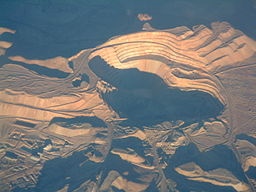
Chuquicamata_copper_mine_chile (1)

Chuquicamata copper mine, by Owen Cliffe

With communities in Chile’s Atacama Desert — one of the world’s driest — competing with copper mines for dwindling water supplies, some of the country’s lawmakers have submitted a bill that would force mining companies to use desalinated Pacific Ocean water, according to reports in Bloomberg and Mining.com.

A statement from Chile’s Chamber of Deputies, the lower house of the National Congress, calls for mining companies that use 150 liters (40 gallons) of water per second to begin using desalinated water in order to preserve freshwater for other uses.  Some mining companies already use desalinated water, others don’t. There is no word yet on when the upper house, the Senate, will address the legislation.

One third of the world’s copper supplies comes from Chile, and one third of the Chilean government’s revenue comes from copper exports — making mining one of the country’s most important industries as well as one of its biggest users of water. According to a report in BNamericas, the industry’s need for water is expected to increase by 38 % by 2021.

Leave a comment

Filed under Desalination, Industry, Law, Oceans, South America, Water Shortage

Groups Slap Nestle’s Human Rights Assessment as ‘PR Stunt’

Image: Nestle S.A.

Image: Nestle S.A.

Several non-governmental organizations (NGOs) are criticizing Nestlé’s recently released human rights impact report as a PR stunt that overlooks the human right to water, among other allegations, reports Caroline Scott-Thomas of FoodNavigator.com.

Vevey, Switzerland-based Nestlé, the world’s largest food company, had trumpeted that its report, released just before International Human Rights Day, was the first of its kind from a multinational corporation. It’s called “Talking the Human Rights Walk: Nestlé’s Experience Assessing Human Rights Impacts in its Business Activities.” The company’s partner in the research, the Danish Institute for Human Rights, referred to the report as a “breakthrough.”

According to Nestle, the paper “focuses on actions Nestlé has taken to improve its human rights performance at both country operations and corporate level,” and assesses data from Angola, Colombia, Kazakhstan, Nigeria, Russia, Sri Lanka, and Uzbekistan.

Certain NGOs see it as little more than window dressing on the company’s reputation. Among charges surfaced in the FoodNavigator.com article: The report is selective, with a limited scope and significant omissions, and that it looks at corporate policy rather than practice. The NGOs concerned are Blue Planet Project,  FIVAS, Food and Water Watch, and Public Services International. Nestlé says it rejects the NGOs’ criticisms.

This is far from the first time Nestlé has come under fire from NGOs and other organizations. Frequently cited as the world’s largest producer of bottled water, it has been criticized for wanting to privatize water (which it denies). The company has gone to court in several places, opposed by groups trying to defend regional groundwater from being taken and sold elsewhere at a profit to others.

To those who see water a human right in a world where hundreds of millions of human don’t have enough of it, the idea of water as a commodity sold for profit by corporations seems wrong.  Several documentary films have tackled the subject, including Tapped,  Bottled Life: The Truth About Nestle’s Business With Water, and Blue Gold: World Water Wars. For the record,  Nestlé Chairman Peter Brabeck-Letmathe has said that he believes water is a human right. But in the recent past, he struck a different tone.

Leave a comment

Filed under Africa, Asia, Human rights, Research, South America, Sustainability, Uncategorized, Water Resources, Water Shortage

Unchecked Emissions Will Drain Water Resources, Warns Leaked UN Report

Photo: MarkDhawn

Photo: MarkDhawn

The Hindu newspaper of India says that a United Nations report leaked online warns of dire consequences for freshwater resources if greenhouse gases remain unchecked.

The report is reportedly a final draft by the Working Group II of the UN Intergovernmental panel on climate change (IPCC), sent to all governments for comment before being finalized and released.

“In response to on-going climate change, terrestrial and marine species have shifted their ranges, seasonal activities, migration patterns, and abundance, have demonstrated altered species,” notes the report’s summary, adding that  developing countries, especially, are vulnerable to damaging climatic events (e.g., heat waves, droughts, floods and wildfires).

Regarding freshwater availability, the summary warns:

“Climate change will reduce renewable surface water and groundwater resources significantly in most dry subtropical regions, exacerbating competition for water among sectors. Each degree of warming is projected to decrease renewable water resources by at least 20% for an additional 7% of the global population.”

As the report notes, dried-up water sources will hurt crop yields even as demand surges with population growth.

Leave a comment

Filed under Climate Change, Environment, Research, United Nations, Water Shortage

Water Crisis Facts from International Sources Now Available

In the past day, this blog saw its new Water Resources page come online, and now it’s joined by another informative page that will be updated on a regular basis: Water Facts. Like the resources page, it’s a quick-reference guide. It gives a sense of urgent issues related to water, such as the number of people worldwide whose lack of it could be life-threatening, as well as less-dire, yet nonetheless interesting, facts (wait, it takes how many gallons of water to produce one hamburger?!)

Leave a comment

Filed under Agriculture, Blog Changes and Updates, Environment, Human rights, Research, Water Resources, Water Shortage

Drying Up: 11 U.S. Cities May Run Out of Water by Midcentury

In case you missed it: The Huffington Post reported last week on the water woes of 11 U.S. cities that could run out water by around 2050 — including some that might be surprising to you. Drawing on recent reports from NOAA’s Cooperative Institute for Research in Environmental Sciences and the Columbia University Water Center, and quoting some of the authors,  HuffPo’s Matt Ferner pointed out that water shortage issues could impact much more of the U.S. during the same time frame. This list simply covers 11 major cities, in order by population below.

The cities:

11. Salt Lake City, Utah

10. Lincoln, Neb.

9. Cleveland, Ohio

8. Miami, Fla.

7. Atlanta, Georgia

6. Washington, D.C.

5. El Paso, Texas

4. San Antonio, Texas

3. San Francisco Bay Area, Calif.

2. Houston, Texas

1. Los Angeles, Calif.

Read the full story, with links to the research materials.

Leave a comment

Filed under Environment, North America, Research, Water Shortage

Study Describes Vast Reserves of Water Under Ocean Floors

cropped-p1000842-4.jpg

Image: David Snow

On the very day I was beginning to put together this blog, Dec. 5, the journal Nature published a new study by a group of Australian researchers that may seem to negate any need for another blog about the looming global water crisis.

The study, Offshore fresh groundwater reserves as a global phenomenon, finds that fresh and brackish water deposits under oceans are much more common, and much more vast, than previously thought.  The research team estimates that the reserves amount to 120,000 cubic miles of water.

“The volume of this water resource is a hundred times greater than the amount we’ve extracted from the Earth’s sub-surface in the past century since 1900,” the study’s lead author, Dr. Vincent Post, said in a statement. He and his team are at of the National Centre for Groundwater Research and Training and the School of the Environment at Flinders University in Adelaide, Australia.

Post explained that the oceans are at much higher surface levels today than they were 20,000 years ago, when polar ice caps began to melt, adding water volume over time. What was once ground has aquifers filled with groundwater underneath. These aquifers, though underneath large bodies of salt water, are otherwise similar to the ones under dry land that are being depleted all over the world.

So, if there’s so much more water out there than we thought, why should I continue to study it as a precious and finite resource that could cause more global conflict than oil in the coming decades? Because of what lies between these massive reserves of water and their ability to sustain people and communities: complex infrastructure and high costs. As Post and his team point out, the water will have to be pumped from ocean platforms or facilities on nearby dry land. That, plus the need for desalination, make getting the water where it’s needed, in a drinkable state, a tall order. On the plus side, as the study indicates, the water is not as salty as seawater, so the desalination is that much less energy-intensive.

After all is said and done, however, this massive “new” resource is still finite. As Post noted, aquifers under oceans won’t be refilled with new groundwater until the oceans recede again, “which is not likely to happen for a very long time.” (Possibly a bit of understatement, that.)

Read more about the study and its implications.

UPDATE: Offshore fresh water aquifers: Which law will apply? – International Water Law Project Blog
Leave a comment

Filed under Desalination, Groundwater, Oceans, Research, Technology, Water Shortage