Category Archives: Water Shortage

EC Awards 50 Million Euros to 11 Innovative Water Projects

Image: European Commission

Image: European Commission

In Brussels on Thursday, the European Commission unveiled 11 projects slated to receive €50 million to support their innovative responses to “water-related challenges” (to put a lot of different fish in one tank, so to speak).

The projects involve 179 partners representing research organizations and private companies across 19 European countries. There’s a lot of variety in the types of work, as well. Three examples: smarter management of water distribution networks; biotech treatment of heavy metal pollution in wastewater; and new “aquaponic” systems combining aquaculture and hydroponics in agricultural production.  You can see the project names and acronyms listed in the tags accompanying this post, and more description of each project can be found here.

The funds come from the 2013 “Environment call” for projects of the European Union’s s Seventh Framework Programme for Research and Technological Development (FP7). This brings total FP7 funding for water-related projects, 2007 – 2013, to more than €1 billion. A new funding initiative rolled out this month, the Horizon 2020 program, is expected to bring another €165 million to water projects in its first round of calls.

Read more:

UPDATE: Event presentations now uploaded

European Commission press release

A summary of each of the 11 projects

European Union water policy overview

Leave a comment

Filed under Agriculture, Awards and Honors, Conservation, Environment, Europe, Events, Industry, Pollution, Research, Sustainability, Technology, Wastewater Treatment, Water Resources, Water Shortage

The News From Davos: Big Business Now ‘Cares’ About Climate Change

Image: Fabrice Coffrini/AFP/Getty

Image: Fabrice Coffrini/AFP/Getty

A chill runs through me whenever I hear a sample of the gaffe from Mitt Romney’s 2011 presidential campaign speech in Iowa: “Corporations are people, my friend.” He was responding to a heckler. What he said was accurate in the eyes of the law in the United States; a corporation has the legal status and rights of a person. But it’s not hard to imagine that Romney was cheerfully referring to psychopathic friends who would blithely step over your body to reach profit.

Corporations as psychopaths is not a new idea, of course. The 2003  Canadian documentary film “The Corporation” makes the case, in a clinical sense, that if corporations are people, they’re psychos. Put simply, they lack empathy for others. They focus on profit alone. The free market rewards such self-interested ruthlessness.

Judging by news from the World Economic Forum in Davos, Switzerland, public opinion and, more importantly, harsh economic reality, are pushing the corporate world to see that self-preservation now actually requires reactions to climate change. Many of today’s meetings of politicians, business leaders and reps from aid organizations in Davos, and a record number for the event overall, are about climate change and sustainable business practices. That’s a lot of talk from some influential people, and now that it’s about money as much as it is about doing good (or appearing to do so), maybe it will make a difference.

And, of course, as the mainstream media has well-recorded, the actor Matt Damon received an award in Davos for his work as co-founder, with Gary White, of Water.org, which works on access to freshwater for the world’s 800+ million who lack it. Damon is one of four recipients of the WEF’s Crystal Award, for artists who have contributed to a better world. The others are Peruvian opera star Juan Diego Flórez, American violinist and conductor Lorin Maazel, and the Iranian-born artist Shirin Neshat.

Read more:

Industry awakens to the threat of climate change – The New York Times

Davos 2014: live and archived blog coverageGuardian Sustainable Business

2014 World Economic Forum: live updates from Davos – The Huffington Post

World Economic Forum 2014 Meeting – WEF

Leave a comment

Filed under Awards and Honors, Climate Change, Conservation, Environment, Europe, Events, Industry, NGOs, Sustainability, Water Resources, Water Shortage

Calif. State of the State Address: Brown’s Drought Plan in Broad Strokes

Calif. Gov. Brown delivers 2014 State of the State Address. Photo Credit: Justin Short, Office of the Governor.

Calif. Gov. Brown delivers 2014 State of the State Address. Photo Credit: Justin Short, Office of the Governor.

Yesterday, the same day I wrote about California’s dire 3-year drought, California Gov. Edmund G. Brown Jr. laid out the state’s plan regarding the water shortage in his annual State of the State address to the California legislature. It’s not the governor’s job to provide exhaustive detail here, and he doesn’t. The drought got about 15 of the speech’s 130 lines.

Here’s the part of the address about the drought:

Among all our uncertainties, weather is one of the most basic. We can’t control it. We can only live with it, and now we have to live with a very serious drought of uncertain duration. 

Right now, it is imperative that we do everything possible to mitigate the effects of the drought. I have convened an Interagency Drought Task Force and declared a State of Emergency. We need everyone in every part of the state to conserve water. We need regulators to rebalance water rules and enable voluntary transfers of water and we must prepare for forest fires. As the State Water Action Plan lays out, water recycling, expanded storage and serious groundwater management must all be part of the mix. So too must be investments in safe drinking water, particularly in disadvantaged communities. We also need wetlands and watershed restoration and further progress on the Bay Delta Conservation Plan.

It is a tall order.

But it is what we must do to get through this drought and prepare for the next.

We do not know how much our current problem derives from the build-up of heat-trapping gasses, but we can take this drought as a stark warning of things to come. The United Nations Panel on Climate Change says – with 95 percent confidence – that human beings are changing our climate. This means more droughts and more extreme weather events, and, in California, more forest fires and less snow pack.

UPDATE: California drought prompts first-ever “zero water allocation” – Los Angeles Times

Related Posts:

Civilization Lost? California’s 500-Year Drought Potential (Jan. 22, 2014)

Leave a comment

Filed under Climate Change, Conservation, Drought, Environment, Events, North America, Water Resources, Water Shortage

Civilization Lost? California’s 500-Year Drought Potential

Image: NOAA

Image: NOAA

As a California resident for 18 years after college, I got to know dry weather pretty well. Right from the start, having arrived in the San Francisco Bay Area in the middle of the 1987  – 1992 drought, I came to see cloudless skies, brown grass and the occasional dryness-induced nosebleed as normal — so much so that the the incessant winter rains that returned years later seemed, briefly, to be freakish.

Now the state is in an even worse dry period — 2013 was the driest year since record-keeping began in the 1840s — and predictable doom-saying has ensued. It’s pretty hard to resist. After all, we know from the geological record that droughts in the area hundreds and thousands of years ago sometimes lasted decades, or even a century. Droughts of that magnitude have ended civilizations. See the Anasazi, wiped out in the Southwest about 800 years ago.

“Driest year since the 1840s” doesn’t sound good, but the reality is, indeed, probably worse. UC Berkeley paleoclimatologist B. Lynn Graham says old tree rings indicate the area hasn’t been so desiccated since 1580, 434 years ago. She points out that the past 150 years of modern development have been comparatively wetter years than some previous, longer, drier, and, arguably, “normal” periods, as noted above. Those long, dry periods could return.

An interesting characteristic of the drought is the proximate cause pointed out by meteorologists: a ridge of high pressure off the coast is “feeding off itself,” refusing to move or dissipate as it blocks wet weather from reaching land.  The timing is especially bad because California needs winter storms to replace its freshwater, in the form of rains and especially snow melt from the mountains. Sounds like an effect of climate change, something that’s easy to believe but hard to prove.

In addition to Herculean conservation efforts, what could be next for California if the drought persists? Greater Los Angeles and the San Francisco Bay Area are already projected to run out of water by 2050. Perhaps the state will pursue expensive seawater desalination projects on a massive scale, follow China’s lead on sea ice desalination, or go after fresh and brackish water recently found to be in aquifers under oceans.

Read more:

UPDATE: California drought prompts first-ever “zero water allocation” – Los Angeles Times

Why California’s water woes could be just beginning – University of California, Berkeley

California drought: Scientists puzzled by persistence of weather-blocking “ridge” – Christian Science Monitor

The worst drought in the history of California is happening right now – Right Side News

California drought: Water officials look to rules of the ’70s – SFGate

Gov. Brown declares California drought emergencySan Jose Mercury News

Leave a comment

Filed under Climate Change, Conservation, Desalination, Drought, North America, Sustainability, Water Shortage

WFES News: WorldBank Launches Initiative at Water and Energy Summits in Abu Dhabi

Image: World Bank Water

Image: World Bank Water

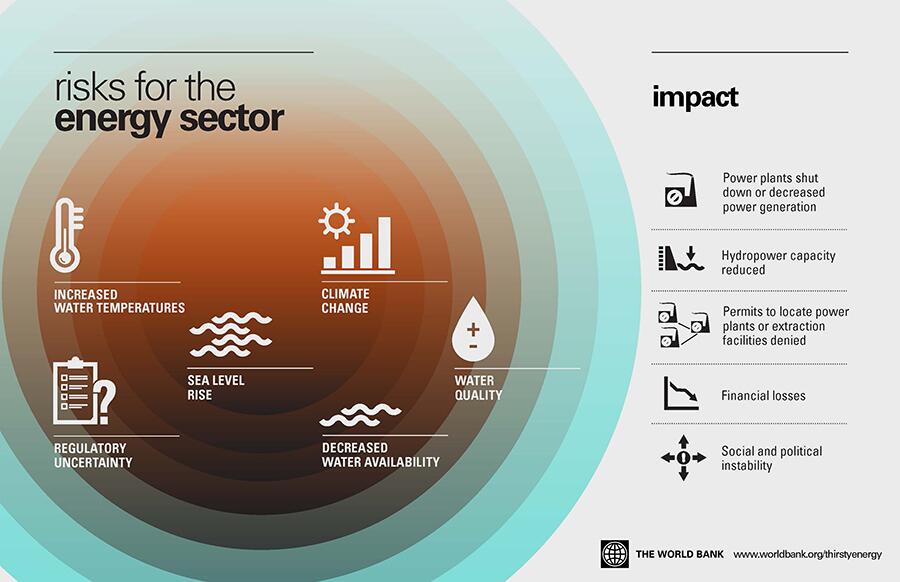
The World Bank has announced the launch of its “Thirsty Energy” initiative, aimed at helping governments tackle growing water-energy challenges, at the 7th annual World Future Energy Summit (WFES) and the 2nd annual International Water Summit (IWS). The two meetings are running concurrently, Jan. 20 – Jan. 22, at the Abu Dhabi National Exhibition Centre in the United Arab Emirates.

It takes a lot of water to generate power through various processes, and it takes a lot of power to extract, treat and deliver water. Yet, according to the World Bank, energy planning and development decisions are often made without regard to current and future water shortages. Its plan is to offer proactive, cross-sector advice on energy and water resource management planning, tailored according to a given country’s resources, modeling experience, and political and institutional realities.

Why go to all that trouble? Because near-future projections paint a disturbing picture. Today more than 780 million people don’t have enough access to potable drinking water, and about 1.3 billion lack electricity, according to estimates. In a world with a fixed and finite amount of freshwater but a surging population, global energy consumption is expected to swell 50% by 2035, while the energy sector’s use of water may increase by 85%. That means worsening water shortages, and, as noted in a previous post, climate change will make the situation even more dire in certain areas.

UPDATE: Thirsty energy: the conflict between demands for water and energyThe Guardian

More from WFES and IWS:

World Bank launches “Thirsty Energy” initiative – The World Bank / WFES

Will water contrain our energy future? (Thirsty Energy initiative, with extensive info graphics) – The World Bank

Four ways water shortages are harming energy production – The Water Blog (blogs.worldbank.org)

Denmark and Abu Dhabi sign clean-energy deal – The National

Related posts:

On tap Monday: Annual UN Water conference in Spain (Jan. 12, 2014)

Study: Freshwater shortage will double climate change’s impact on agriculture (Dec. 17, 2013)

Leave a comment

Filed under Climate Change, Conservation, Desalination, Environment, Events, Industry, Middle East, Research, Sustainability, Technology, Water Resources, Water Shortage

On Tap Monday: Annual UN Water Conference in Spain

Image: UN Water

Image: UN Water

UN Water’s annual conference in Zaragoza, Spain, runs Monday, Jan. 13 through Thursday, Jan 16. This edition plumbs the depths of the relationship of water and energy as a run-up to World Water Day. The small city of Zaragoza is roughly midway between Madrid and Barcelona. I can’t make it to there myself, but I will be on the lookout for interesting news trickling out of the meetings.

As with a lot of UN endeavors, the full name and description of the event are a mouthful (and you can read much, much more fairly dry stuff at the website): 2014 UN-Water Annual International Zaragoza Conference. Preparing for World Water Day 2014: Partnerships for improving water and energy access, efficiency and sustainability.

Or, because it’s easier to navigate and gives a sense of the topics, you can just read the agenda.

World Water Day is March 22. Of course it has its own website, too.  The main “celebrations” — which include the release of a report and the bestowing of an award — will take place in Japan.

Leave a comment

Filed under Conservation, Environment, Europe, Events, Human rights, Industry, Research, Sustainability, Technology, United Nations, Wastewater Treatment, Water Resources, Water Shortage

Water War? Dam Talks Between Egypt and Ethiopia Falter

Nile_River_and_delta_from_orbit

Image: NASA

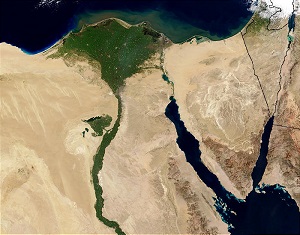
In 1979, Egyptian president Anwar Sadat said if the country ever again went to war, it would be over water. Egypt’s near-total reliance on the Nile River for water has made for tense relations with other Nile Basin countries at times, and Ethiopia’s current construction of the massive Grand Ethiopian Renaissance Dam on the Blue Nile tributary, upriver from Egypt, has led to speculation that war could erupt. Some experts say it probably won’t, because Ethiopia has a strong military and Egypt is no longer under the hawkish sway of Hosni Mubarak, but sabres have been rattled.

Read more:

Update: Egyptian PM says dam negotiations are ‘not over’ (Ahram Online)

Bloomberg reports on Ethiopia’s rejection of Egypt’s latest proposal asserting its right to most of the water.

Aljazeera provides background on this dispute, as well as previous clashes over the Nile.

Ahram Online quotes Egyptian official calling Ethiopian claims of dam progress a “media show.”

Leave a comment

Filed under Africa, Conflicts, Rivers and Watersheds, Water Shortage

To the Rescue in California? Solar-Powered Desalination

solar desal water fx

Image: WaterFX

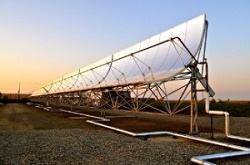
When you hear about desalination, it’s usually about a large-scale effort to transform seawater to freshwater through the process of reverse osmosis. In other words, an industrial plant is built in a terribly dry place at considerable expense, and salt water is pumped in and forced through membranes to create much-less-salty water (to oversimplify). But there is another, completely different process that separates salt and other things from water using a “solar still.”

Solar desalination technology isn’t new, but a company called WaterFX* is trying to put it to a new use in water-challenged California, and, potentially, everywhere, according to an interesting article in Forbes (link below). The company’s effort is about selling its scalable Aqua 4 system to growers and water districts, who can use it to recapture, purify and reuse agricultural run-off (that is, the copious amount of water used for irrigation that picks up salts, fertilizer and other impurities that make it problematic to reuse without damaging crop yields). The company’s small-scale pilot project with California’s  Panoche Water District was able to produce nearly 500 gallons of clean water per hour, and the district plans to launch a larger project with the company, according to the article below.

Read more about how the sytem works in Peter Kelly-Detwiler’s* piece for Forbes.

Read more about WaterFX* at its website.

(*Note: Peter Kelly-Detwiler is a partner at NorthBridge Energy Partners, LLC. This post is not an endorsement of that organization or of WaterFX.)

Leave a comment

Filed under Agriculture, Conservation, Desalination, Industry, North America, Technology, Water Resources, Water Shortage

Taxing Bottled Water to Link the Luxury to the Human Need

Image: LeeBrimelow

Image: LeeBrimelow

With the At the Waterline blog, I’m writing about water issues as I learn about them. Almost every day, I learn something new. It’s exciting, but it also makes me feel perpetually late to the party. Today I saw that people have been entering “Jorge Viñuales” into the blog’s search box, so I looked him up. That led me to a 13-month-old YouTube video entitled, “A Tax on Bottled Water: Jorge Viñuales at TEDx Zurich.”

In the video, Viñuales, a lawyer and law professor (see credentials below), suggests a small transactional tax on bottled water that would be used “(1) for the protection of the natural infrastructures that maintain the water cycle, i.e. wetlands, (2) for direct local water distribution and sanitation projects (e.g. for the coordination of inter-city projects), and (3) for research on water efficiency, decontamination and alternative techniques (e.g. exploitation of melting iced-water).”

Citing the $50 billion European bottled water market as an example, Viñuales says that a 3% tax could raise $1.5 billion (presumably annually). Viñuales acknowledges that some people think we all should stop drinking bottled water entirely, but he argues that “sermonizing” people is not the best way to effect environmental policy change. As such, he suggests what seems like a more practical step, in order “to link water as a luxury to a real problem … access to water as a human need.”

Whether bleeding bottled-water companies financially would work in practice, and do enough to fund programs to help those in immediate need as well as discover new or more efficient ways to get freshwater, are other questions — ones that a 12-minute TED talk can’t cover in any depth. Viñuales did mention, however, his work on a legal framework to manage freshwater resources trapped in ice (e.g., towing icebergs; extracting freshwater from icebergs is a serious subject of study).

Viñuales is a practicing lawyer, the Harold Samuel Professor of Law and Environmental Policy at the University of Cambridge, United Kingdom, and a Visiting Professor of International Law at The Graduate Institute, Geneva, Switzerland, during the academic year 2013-2014. Two of Viñuales’ most recent books are Foreign Investment and the Environment in International Law (Cambridge University Press, 2012) and Harnessing Foreign Investment to Promote Environmental Protection: Incentives and Safeguards (Cambridge University Press, 2013, co-edited with P.-M. Dupuy),

Leave a comment

Filed under Bottled Water, Events, Industry, Law, Oceans, Water Resources, Water Shortage

China Raises Water Prices for Top Users

Image: Houhai, Beijing, by D. Snow

Image: Houhai, Beijing, by D. Snow

In case you missed this Wall Street Journal report yesterday: “To Conserve Water, China Raises Prices for Top Users.”

It’s worth noting that China is merely raising its comparatively low water rates, and mainly for those who use the most water. It’s a new, three-tiered pricing structure, announced Friday, that is part of larger plan to restructure utility pricing nationwide. The water rates are considered low because they amount to 0.5% of disposable income. By comparison, Australia’s rates are 8.6%, Japan’s are 2.9%, the U.S.’s are 2.8%, and South Korea’s are 1.3%.

Note, also, that most people in China don’t drink tap water. They drink bottled water. I was amazed to be told of this and witness it when I visited Beijing and Yunnan Province in 2012. That’s more than a billion people filling landfills and that huge Pacific Ocean garbage patch with plastic. Experts say the new pricing structure is likely a precursor to upgraded drinking water standards in the country, which, with new investment in infrastructure, could be in place as soon as 2015, according to the WSJ report.

Leave a comment

Filed under Asia, Climate Change, Groundwater, Water Shortage