Category Archives: United Nations

At the Point of ‘Peak Water,’ Our Foreseeable Future Grows Shorter

Watercyclesummary

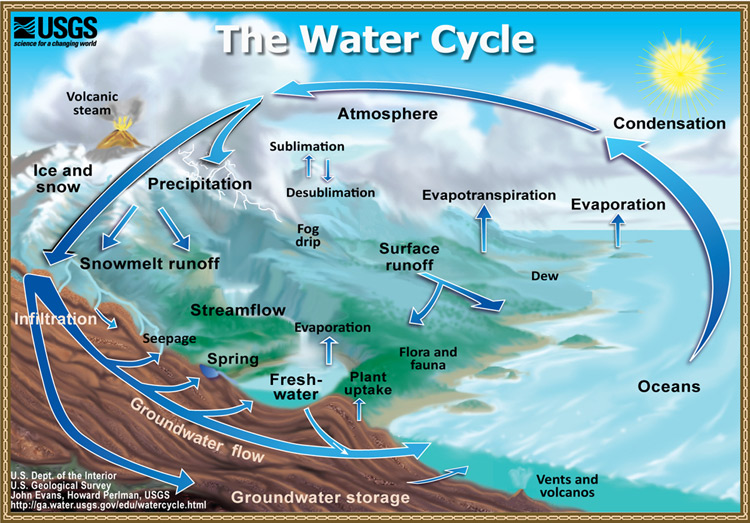
The world has a finite supply of accessible freshwater. By some estimates, less than 1% of the naturally occurring freshwater on earth is accessible to humans; the rest is locked up in ice or too deep and dispersed in the ground for us to get. The phrase “peak water” refers to the point at which we’re consuming available freshwater faster than it can be replenished by nature through the hydrologic water cycle to the usual sources, such as lakes, rivers, and shallow underground aquifers, many of which are already dangerously depleted.

Whether we’re nearing the point of peak water, already there, or well past it is a question under ongoing discussion. One point of confusion is that water volume and use vary widely by region. Some areas are nearing or past peak water, others aren’t. Another factor is that climate change is throwing the status quo of water abundance or scarcity by region into flux. Look at the 2013 research showing that heavy pollution from the U.S. and Europe from the 1960s into the 1980s effectively changed weather patterns, becoming a primary cause of Africa’s long, widespread, and deadly Sahel Drought. What will happen because of today’s pollution from the world’s most prolific sources? (e.g., China).

And those who don’t see water and climate change as parts of the same series of problems should note: “The hydrologic cycle is the climate cycle,” says hydro-climatologist Dr. Peter Gleick, co-founder of the Pacific Institute, in a video interview that lays out overlapping problems. Water, climate change, and energy production are all inextricably linked. In fact, links between water and energy make up the theme of this year’s World Water Day, coming up on March 22.

It’s worth noting that water scarcity is a crucial element of the resource crises cited in the upcoming NASA-funded study predicting a “perfect storm” within a few decades that could end global civilization. The study looked closely at the fall of previous complex societies, such as the Mayans and Romans, and found parallels with our unsustainable overuse of resources — particularly the massively unequal use by wealthy versus poor.

However close to “peak” we may be, no sustained sense of urgency over water scarcity is apparent in mainstream media. In part this is because water supplies are local or regional, not global, and in part it’s because these problems take a long time — and a much longer attention span than a 24-hour news cycle has — to address. So you see localized articles about regional droughts and potential conflicts over resources, though rarely anything that puts the worldwide water crisis in perspective and looks ahead to cross-cutting solutions (e.g., large-scale renewable-energy power production that requires much less water than nuclear or fossil-fuel-based power, combined with modern and far-reaching conservation measures addressing agricultural, industrial, and residential water use and re-use).

Compared to today’s world, our near-future planet will have double the human population, even more-severe climate change, and yet the same old freshwater, redistributed. Perhaps it’s too easy to push off the worry, as we think we’ll get serious about conservation before it’s too late. Or that governments and industry will join together to provide desalinated water wherever necessary — somehow without the troubling environmental costs of today’s practices — before vast human populations must migrate or die.  Or that those fresh and brackish aquifers recently discovered under the oceans will push the point-of-no-return a few decades further into the future. Well, someday, after the fights over the rights, maybe somebody will throw billions at drilling into those aquifers. Because someday they’ll have no choice. And then those reserves will be sucked dry, too.

You might say we have no choice other than to better manage our freshwater.

Read more:

UPDATE: CHARTS: How power generation threatens water supplies, and climate change threatens both – ClimateProgress

UPDATE: NASA-funded study: Industrial civilisation headed for “irreversible collapse”? Natural and social scientists develop new model of how “perfect storm” of crises could unravel global systemThe Guardian

Are we on the path to peak water? – Climate Central (with infographic)

Peak water is here – Daily Kos (links to video interview with Dr. Peter Gleick of the Pacific Institute)

Peak water (background) – Wikipedia

Pollution in Northern Hemisphere helped cause 1980s African drought – Washington University

Related posts:

Mapping the World’s Most Water-Stressed Countries

Serious Water Conservation Demands Layered Approach and Emotional Commitment

Over-Salted: The Trouble(s) With Desalination

Study: Freshwater Shortage Will Double Climate Change’s Impact on Agriculture

Unchecked Emissions Will Drain Water Resources, Warns Leaked U.N. Report

Study Describes Vast Reserves of Water Under Ocean Floors

Leave a comment

Filed under Africa, Agriculture, Climate Change, Conservation, Desalination, Drought, Europe, Groundwater, Industry, North America, Pollution, Research, Rivers and Watersheds, Sustainability, Technology, United Nations, Wastewater Treatment, Water Resources, Water Shortage

UNICEF Says Put Down Your Cell Phone for a Few Minutes to Help Kids Get Water

UNICEF tap project phone

A lot of us incessantly check email, apps and websites on our smartphones. We joke, semi-seriously, about the addiction. Well, now we have help in our struggle that provides built-in motivation, because taking advantage of it will directly benefit others trapped in a far worse struggle.

Take part in UNICEF’s Tap Project, and for every 10 minutes you manage not to touch your phone, a donation will be made to provide help to the 768 million people around the world who lack access to clean water. And if you can’t put the thing down during the day, take heart: You can rack up time while you sleep. Whatever time you log, the donated funds will finance construction and maintenance of water wells, water pipes to rivers, and purification equipment, according to UNICEF.

Using the browser on your phone, go to uniceftapproject.org to take part.

Read more:

UNICEF Tap Project

Do without your phone and improve someone’s water – Fast Company Co.Exist

If you put down your cell phone for 10 minutes, a child will get a day’s worth of clean drinking water – Time

2 Comments

Filed under Africa, Asia, Caribbean, Human rights, Middle East, NGOs, North America, Rivers and Watersheds, South America, United Nations, Water Resources, Water Shortage

Water Resources Spotlight: Green Growth Knowledge Platform

Image: piazzaffari.info

Image: piazzaffari.info

Last month the launch of the Green Growth Knowledge Platform (GGKP) coincided with the opening of the organization’s office at the International Environment House in Geneva, Switzerland, on Jan. 22. It was a stellar opportunity for me to get out of the house, but I missed it. So I doubled back and talked by phone with the group about its efforts.

What’s the point of GGKP? As Benjamin Simmons, the organization’s head. puts it in this succinct-yet-comprehensive overview: “Our aim is straightforward: to give policy makers, academics, experts and other professionals easy access to the most relevant green growth studies, policy analysis, guidance and data.”

It’s all about putting the best information about sustainable development and ways of reaching the goal of a “green economy” in front of the right people.  The link in the previous sentence goes to the UN Environment Programme (UNEP), which boils down the definition of green economy to its essence: It’s low carbon, resource efficient and socially inclusive. 

“The first part of our mission is about catalyzing research in and  around green growth,” said Amanda McKee, GGKP’s communications and outreach officer, based in Washington, D.C. “The second part of our mission is to make all the research acceptable to policy makers and practitioners.”

The data in the platform covers a lot of ground. The resource library contains about 600 publications organized by sector (e.g., water) and cross-cutting theme (e.g., gender), McKee said, adding that data is also organized geographically, representing 193 countries (see the Green Growth Map).

There’s also a collaborative element aimed at filling green-growth knowledge gaps. Currently, committees are looking at four topics: trade and competitiveness, technology and innovation, measurement and indicators, and fiscal instruments.  “If we’re able to generate results from this, we’ll branch out into other topics and launch new committees,” McKee said.

And how will GGKP know if it’s succeeding in its overall mission?

“We’re in the process of developing indicators for measuring success,” McKee said. “In terms of the knowledge-generation aspect, I think the way we’ll measure success is how much of this research is  ultimately picked up by these communities. On the knowledge-management side, a sign of success would be how many policy makers or government officials are making use of resources to put in place green-growth strategies or policies.”

The GGKP was established by the Global Green Growth Institute (GGGI), the Organisation for Economic Co-operation and Development (OECD), the United Nations Environment Programme (UNEP), and the World Bank, where it was initially “incubated,” McKee said. Those steering organizations provide in-kind contributions and part-time staffing to GGKP, while strategic funding comes from the government of Switzerland, which is providing 1.6 million CHF over three years.

GGKP’s main event is its annual conference; the next one, organized by UNEP, will take place in February 2015.  The group sometimes stages side-events at major conferences, like the “open-thinking event on the expansion of green-growth knowledge” planned for UNEP’s inaugural Partnership for Action on Green Economy (PAGE) conference coming up in Dubai, UAE, March 4-5, McKee said.

Leave a comment

Filed under Climate Change, Conservation, Environment, Europe, Events, Human rights, NGOs, Pollution, Research, Science, Technology, United Nations, Water Resources

First EU Citizens’ Initiative Calls for Right to Water and Sanitation

Image: Right2Water.eu

Image: Right2Water.eu

European Union law should guarantee the right to water and sanitation, the first valid EU citizens’ initiative has said. It also called for water services not to face liberalisation, collecting 1.8 million signatures after a campaign called Right2Water, which was backed by a string of NGOs and by the European Federation of Public Service Unions (EPSU). The activists held talks with the European Commission and MEPs on Monday in Brussels to mark the event. – Benjamin Fox, EUobserver

Read more:

Parliament kicks off debate on the legal right to water – EurActiv.com

Right2Water urges privatisation ban in first EU Citizens’ Initiative debate – European Parliament News

Interview: “Water is not a commodity, it is part of our heritage.” – European Parliament News

Right2Water website

Leave a comment

Filed under Europe, Human rights, Law, NGOs, United Nations, Water Resources, Water Shortage

WaterLex Helps Put the Human Right to Water Into New Legal Frameworks

Image: WaterLex

Image courtesy of WaterLex

One of the benefits of living in Geneva, Switzerland, is that I have access to the United Nations and international organizations that work with it. WaterLex, for example, is an international NGO that partners with UN Water. It takes an interesting, forward-looking, “lawyerly” approach to working on issues related to freshwater scarcity. The group, with a staff of seven based here, helps water-governance stakeholders in various countries establish policies and standards that comply with the human right to water and sanitation (HRWS). To do its work, the staff consults with more than 100 international experts in water management, development and law.

Many water NGOs work on access to water, helping people in water-stressed communities survive by delivering clean water, digging wells, installing pumps, and so forth. WaterLex attacks the problem close to its root and in a way that helps enable water security for future generations: It trains lawmakers and others with influence over water resources in a community, or a country, on how to implement new legal frameworks in which the human right to water is central.

WaterLex Executive Director Jean-Benoit Charrin co-founded the organization in 2010, the same year the human right to water and sanitation became fully recognized. I spoke with him on Tuesday at the WaterLex offices down the street from the Palace of Nations (UN). The rest of the staff, a mix of lawyers and operations experts, were away on missions. Although I would have liked to meet them, I’m glad they were off doing their work.

“There are four things we never want to hear people say again,” Charrin said. “That they didn’t know there was a problem. That they know there is a problem, but they don’t know how to deal with it. That they know there is a problem and how to deal with it, but they don’t know how to get the money. And finally, that they know there is a problem but they don’t care.” He paralleled the four statements succinctly with four WaterLex work areas:  providing assistance with information, capacity-building, budgeting, and accountability. Learn more about the group’s work below.

WaterLex tools (naturally, these are also on the Water Resources page):

WaterLex Legal Database on the Human Right to Water and Sanitation

WaterLex Toolkit: Integrating the Human Right to Water and Sanitation in Development Practice

Examples of WaterLex activities:

  • Worked with 10 universities to develop its online Legal Database (link above), a reference tool for policy makers that enables them to harmonize their legal frameworks with HRWS.
  • Trained more than 40 members of the Pan African Parliament on the integration of national legal frameworks with HRWS.
  • Partnered with the UN Development Programme (UNDP) to advise the government of Niger on designing a decentralized cooperation strategy that complies with human rights obligations.
  • Drafted a resolution adopted by the African Commission on Human and People’s Rights clarifying legal responsibilities of states in the management of water as a result of human rights commitments.
  • Worked with the Swiss Agency for Development Cooperation (SDC) to develop a toolkit and field training for water program managers in Nicaragua, Moldova and Mozambique.
  • Assisted the UN Economic Commission for Europe (UNECE) in the design of an Equity Score Card to help governments assess their population’s relative access to safe and affordable drinking water.

Leave a comment

Filed under Africa, Conservation, Drought, Europe, Groundwater, Human rights, Law, NGOs, Pollution, Research, Rivers and Watersheds, South America, United Nations, Water Resources, Water Shortage

On Tap Monday: Annual UN Water Conference in Spain

Image: UN Water

Image: UN Water

UN Water’s annual conference in Zaragoza, Spain, runs Monday, Jan. 13 through Thursday, Jan 16. This edition plumbs the depths of the relationship of water and energy as a run-up to World Water Day. The small city of Zaragoza is roughly midway between Madrid and Barcelona. I can’t make it to there myself, but I will be on the lookout for interesting news trickling out of the meetings.

As with a lot of UN endeavors, the full name and description of the event are a mouthful (and you can read much, much more fairly dry stuff at the website): 2014 UN-Water Annual International Zaragoza Conference. Preparing for World Water Day 2014: Partnerships for improving water and energy access, efficiency and sustainability.

Or, because it’s easier to navigate and gives a sense of the topics, you can just read the agenda.

World Water Day is March 22. Of course it has its own website, too.  The main “celebrations” — which include the release of a report and the bestowing of an award — will take place in Japan.

Leave a comment

Filed under Conservation, Environment, Europe, Events, Human rights, Industry, Research, Sustainability, Technology, United Nations, Wastewater Treatment, Water Resources, Water Shortage

Unchecked Emissions Will Drain Water Resources, Warns Leaked UN Report

Photo: MarkDhawn

Photo: MarkDhawn

The Hindu newspaper of India says that a United Nations report leaked online warns of dire consequences for freshwater resources if greenhouse gases remain unchecked.

The report is reportedly a final draft by the Working Group II of the UN Intergovernmental panel on climate change (IPCC), sent to all governments for comment before being finalized and released.

“In response to on-going climate change, terrestrial and marine species have shifted their ranges, seasonal activities, migration patterns, and abundance, have demonstrated altered species,” notes the report’s summary, adding that  developing countries, especially, are vulnerable to damaging climatic events (e.g., heat waves, droughts, floods and wildfires).

Regarding freshwater availability, the summary warns:

“Climate change will reduce renewable surface water and groundwater resources significantly in most dry subtropical regions, exacerbating competition for water among sectors. Each degree of warming is projected to decrease renewable water resources by at least 20% for an additional 7% of the global population.”

As the report notes, dried-up water sources will hurt crop yields even as demand surges with population growth.

Leave a comment

Filed under Climate Change, Environment, Research, United Nations, Water Shortage

Water, Water Everywhere: New Resources Updates

At the Waterline is still a new blog, with fresh information pages still being added. The Water Resources page doesn’t say “coming soon” anymore — it has actual resources! It’s a list, in alphabetical order, of agencies and media sources concerned with water issues. It’s a work in progress, so be sure to check on it from time to time.  Go there.

A Water Facts page is still, ahem, “coming soon.”

Leave a comment

Filed under Agriculture, Blog Changes and Updates, Climate Change, Environment, Groundwater, NGOs, Oceans, Research, Rivers and Watersheds, Sustainability, United Nations, Water Resources

The Intersection of Environmental Issues and Human Rights

Image

The Future of Human Rights Forum, based in Geneva, Switzerland, marked International Human Rights Day, aka the 65th anniversary of the UN General Counsel’s adoption of The Universal Declaration of Human Rights, with a special event: its inaugural forum. The event is meant to bring together various experts, civil society organizations, journalists and members of the public to discuss innovation in response to issues of concern regarding human rights.

As a Geneva-based journalist learning about water and reIated environmental concerns, I attended the forum’s opening remarks and this morning’s discussion, entitled “Placing the Environment on the Human Rights Agenda.” It was interesting to hear the first speaker of the day drop a tantalizing tidbit in anticipation of the panel. John Pace, former head of the Research and Right to Development Branch of the Office of the High Commissioner for Human Rights, referred to the relationship between environmental issues and human rights as “a bit of a hot potato for some of us.”

Listening to the panel discussion that followed, I could understand why the topic is controversial, and why it stands to remain so for some time. There is a lot of history behind human rights development and documentation, and finding the best ways to include environmental issues will be tricky. How central can environmental issues be to human rights in general? How do experts get the language right, when modifying documentation, to ensure clarity? Can the the concept of “ecocide” as a crime gain urgency behind a public mandate and become part of the law in more countries?

The panelists: moderator Nicola Spafford Furey, vice president of Earth Focus Foundation; Polly Higgins, chairwoman, Eradicating Ecocide Global Initiative; Gonzalo Ovideo, senior advisor for social policy, International Union for Conservation of Nature; Jorge Vinuales, Harold Samuel Professor of Law and Environmental Policy at the University of Cambridge.

This blog is focused on water, which was not a main topic of the discussion, but it was used as an example that gives a sense of the scope of some of the issues discussed regarding the overlap of environment and human rights. Oviedo, echoed by Vinuales, mentioned two schools of thought: (1) people who want to protect humans from negative environmental impacts, such as toxic waste, and (2) people focused primarily on procedural environmental rights developed in the past 20 years (e.g., through the Rio Conventions).

“Something in the middle is missing,” Oviedo continued. “I think what is missing is a stronger, better way of understanding the way in which the environment is really at the bottom, is the basis of, human rights. Think of the right to water. Water comes from the function of ecosystems. If the ecosystems that ensure the cycle of water are lost, what are we going to do with the right to water? I feel we have the tools at hand today to make the environmental agenda stronger. We just have to use [them] in a more creative way.”

The focus of much of the discussion, as well as audience questions, was on Higgins’ area of expertise, the Eradicating Ecocide Environmental Initiative. It’s an intriguing idea, that destruction of ecosystems could become an international crime. In fact, it’s on the books in 10 countries, Higgins said. The term itself, first coined in a 1972 research paper, still seems little-known, but could be poised for greater fame. Read more about its history, existing laws, and more on the initiative website.

Image: The Future of Human Rights Forum

1 Comment

Filed under Environment, Events, Human rights, Law, United Nations