UNICEF Says Put Down Your Cell Phone for a Few Minutes to Help Kids Get Water

UNICEF tap project phone

A lot of us incessantly check email, apps and websites on our smartphones. We joke, semi-seriously, about the addiction. Well, now we have help in our struggle that provides built-in motivation, because taking advantage of it will directly benefit others trapped in a far worse struggle.

Take part in UNICEF’s Tap Project, and for every 10 minutes you manage not to touch your phone, a donation will be made to provide help to the 768 million people around the world who lack access to clean water. And if you can’t put the thing down during the day, take heart: You can rack up time while you sleep. Whatever time you log, the donated funds will finance construction and maintenance of water wells, water pipes to rivers, and purification equipment, according to UNICEF.

Using the browser on your phone, go to uniceftapproject.org to take part.

Read more:

UNICEF Tap Project

Do without your phone and improve someone’s water – Fast Company Co.Exist

If you put down your cell phone for 10 minutes, a child will get a day’s worth of clean drinking water – Time

2 Comments

Filed under Africa, Asia, Caribbean, Human rights, Middle East, NGOs, North America, Rivers and Watersheds, South America, United Nations, Water Resources, Water Shortage

Another Voice for Water in the Blogosphere

SIWI logo

Another water blog online means another hopeful drop in the bucket for a wet and fruitful future. The Stockholm International Water Institute (SIWI), one of the first organizations added to this blog’s Water Resources page, has launched a water blog that, in the word’s of SIWI’s executive director, Torgny Holmgren, is aimed at “sharing knowledge to realize a water wise world.”

In the blog’s “welcome” post, on Feb. 24, Holmgren said the fast-growing SIWI enables knowledge-sharing and networking among scientists, businesses, policy makers and civil society workers. As such, Holmgren wrote, the organization’s blog will “host opinions, commentary, photos and videos … as we deliver collaborative projects to solve water issues around the globe.” Read his post.

Leave a comment

Filed under Environment, Europe, Law, NGOs, Water Resources

Canada’s Biggest Coal Power Plant Is First to Bury its Carbon in Saline Aquifer

Trailblazing power plant is first to bury its carbon – environment – 5 March 2014 – New Scientist

Leave a comment

Filed under Climate Change, Environment, Industry, North America, Technology

Study: Americans Use Twice the Water They Think They Do

Image: treehugger.com

Image: treehugger.com

Americans use twice the amount of water they think they do, and appear to be particularly oblivious about how much H2O they flush down the toilet on a daily basis, according to new research. In a paper published online Monday in the journal PNAS, a researcher concluded that Americans underestimated their water use by a factor of 2, and were only slightly aware of how much water goes into growing the food they eat … ”
By Monte Morin, Los Angeles Times

Related pages: Water Facts, Water Resources

Leave a comment

Filed under Conservation, North America, Research, Water Resources, Water Shortage

Mapping the World’s Most Water-Stressed Countries

Image: thaibiodiversity.org

Image: thaibiodiversity.org

Playing with maps can be fun — except when it’s totally depressing.

In adding China Water Risk, an interesting information source, to this blog’s Water Resources page, I was reminded of another one I had already added: World Resources Institute (WRI), which provides a home for Aqueduct’s mapping surveys of water-stressed places. China Water Risk provides a version of WRI’s helpful breakdown of the data and list of 36 most water-stressed countries. So, rather than jumping straight into the mapping tool’s various menus to generate visualizations of data, you can get a bit of an overview of how the tool works and some of its findings.

Aqueduct’s mapping tool, the Aqueduct Water Risk Atlas, uses 12 indicators to value amounts of water stress, and assigns each country a score of up to 5 points, the high end of the scale for potential water stress. Sixteen countries representing a handful of world regions, such as the Caribbean, the Middle East, and parts of Africa and Asia, achieve a perfect(ly dire) score of 5.0. All 36 countries on the list of the most at risk of water stress rank 4.01 or higher, suffering “extremely high risk.” See the list.

Leave a comment

Filed under Africa, Asia, Caribbean, Conflicts, Middle East, Research, Sustainability, Water Resources, Water Shortage

Water Shortages and the Threats of War and Terror

Image: cawater-info.net

Image: cawater-info.net

The prediction that water will outstrip oil — and every other scarce natural resource — as a factor in global conflict has been around for a long time. After all, without water, everybody and everything dies.  There is no substitute for it. Among water-stressed regions, where is conflict likely to strike, and when? In many places, it’s already happening.

Conflict is widespread and ongoing because it can take many forms besides all-out war. In some areas, competition over water may be at the root of tensions between warring factions, though not the only cause. In certain conflicts, water resources may be military or terrorist targets, either to capture or to destroy as a way of hurting the enemy. Elsewhere, protests over water shortages resulting from perceived mismanagement can erupt in violence. The Pacific Institute studies these issues; the conflict chronology at the link below is especially interesting because it shows the whole gamut of water-related struggles.

A useful backgrounder on water-related conflict can be found in Suzanne Goldenberg’s recent piece for The Guardian, also linked below. It identifies six “regions at risk,” due to extreme drought and/or tension over shared resources: California, Brazil, Middle East (Iran, United Arab Emirates, Jordan), North Africa (Egypt and Ethiopia), South Asia (eastern Pakistan, northern India), and China. Stephen Leahy’s IPS article and Giulio Boccaletti’s op-ed for The Nature Conservancy further fill in the picture and scope of global water (in)security.

Read more:

Why global water shortages pose threat of terror and war – The Guardian

In an increasingly unpredictable world, we must secure nature to secure our water – The Nature Conservancy

Water crisis hitting food, energy — and everything else – IPS

Pacific Institute: water and conflict

Pacific Institute: water conflict chronology

Related posts:

Past, Present and Future: California’s Epic Struggle With Water

Water War? Dam Talks Between Egypt and Ethiopia Falter

Leave a comment

Filed under Africa, Asia, Conflicts, Drought, Middle East, North America, Research, South America, Water Shortage

Water Resources Spotlight: Green Growth Knowledge Platform

Image: piazzaffari.info

Image: piazzaffari.info

Last month the launch of the Green Growth Knowledge Platform (GGKP) coincided with the opening of the organization’s office at the International Environment House in Geneva, Switzerland, on Jan. 22. It was a stellar opportunity for me to get out of the house, but I missed it. So I doubled back and talked by phone with the group about its efforts.

What’s the point of GGKP? As Benjamin Simmons, the organization’s head. puts it in this succinct-yet-comprehensive overview: “Our aim is straightforward: to give policy makers, academics, experts and other professionals easy access to the most relevant green growth studies, policy analysis, guidance and data.”

It’s all about putting the best information about sustainable development and ways of reaching the goal of a “green economy” in front of the right people.  The link in the previous sentence goes to the UN Environment Programme (UNEP), which boils down the definition of green economy to its essence: It’s low carbon, resource efficient and socially inclusive. 

“The first part of our mission is about catalyzing research in and  around green growth,” said Amanda McKee, GGKP’s communications and outreach officer, based in Washington, D.C. “The second part of our mission is to make all the research acceptable to policy makers and practitioners.”

The data in the platform covers a lot of ground. The resource library contains about 600 publications organized by sector (e.g., water) and cross-cutting theme (e.g., gender), McKee said, adding that data is also organized geographically, representing 193 countries (see the Green Growth Map).

There’s also a collaborative element aimed at filling green-growth knowledge gaps. Currently, committees are looking at four topics: trade and competitiveness, technology and innovation, measurement and indicators, and fiscal instruments.  “If we’re able to generate results from this, we’ll branch out into other topics and launch new committees,” McKee said.

And how will GGKP know if it’s succeeding in its overall mission?

“We’re in the process of developing indicators for measuring success,” McKee said. “In terms of the knowledge-generation aspect, I think the way we’ll measure success is how much of this research is  ultimately picked up by these communities. On the knowledge-management side, a sign of success would be how many policy makers or government officials are making use of resources to put in place green-growth strategies or policies.”

The GGKP was established by the Global Green Growth Institute (GGGI), the Organisation for Economic Co-operation and Development (OECD), the United Nations Environment Programme (UNEP), and the World Bank, where it was initially “incubated,” McKee said. Those steering organizations provide in-kind contributions and part-time staffing to GGKP, while strategic funding comes from the government of Switzerland, which is providing 1.6 million CHF over three years.

GGKP’s main event is its annual conference; the next one, organized by UNEP, will take place in February 2015.  The group sometimes stages side-events at major conferences, like the “open-thinking event on the expansion of green-growth knowledge” planned for UNEP’s inaugural Partnership for Action on Green Economy (PAGE) conference coming up in Dubai, UAE, March 4-5, McKee said.

Leave a comment

Filed under Climate Change, Conservation, Environment, Europe, Events, Human rights, NGOs, Pollution, Research, Science, Technology, United Nations, Water Resources

Past, Present and Future: California’s Epic Struggle With Water

Image courtesy of Ca.gov

Image courtesy of Ca.gov

Alexis C. Madrigal’s new piece in The Atlantic, which he tweeted is his most ambitious yet, is a good read. It has great descriptions of California’s ongoing, larger-than-life efforts to stay hydrated in a place where nature simply won’t cooperate. The article centers on Gov. Jerry Brown’s $25 billion Bay Delta Conservation Plan, which proposes to dig two tunnels under the entire Sacramento-San Joaquin Delta. If built, they’ll be longer than the Chunnel connecting England and France under the English Channel.

Read more:

American Aqueduct: The Great California Water Saga
A $25 billion plan, a small town, and a half-century of wrangling over the most important resource in the biggest state
Alexis C. Madrigal, The Atlantic

Recent related posts:

Serious Water Conservation Requires Layered Approach and Emotional Commitment

California’s State-of-the-State Address: Brown’s Drought Plan in Broad Strokes

Civilization Lost? California’s 500-Year Drought Potential

To the Rescue in California? Solar-Powered Desalination

Leave a comment

Filed under Agriculture, Conflicts, Conservation, Dams and Hydropower, Drought, Environment, Groundwater, Industry, North America, Rivers and Watersheds, Technology, Water Shortage

Restoring Rivers: American Rivers Announces 51 Dam Removals in 2013, Builds New Interactive Map

dam removal

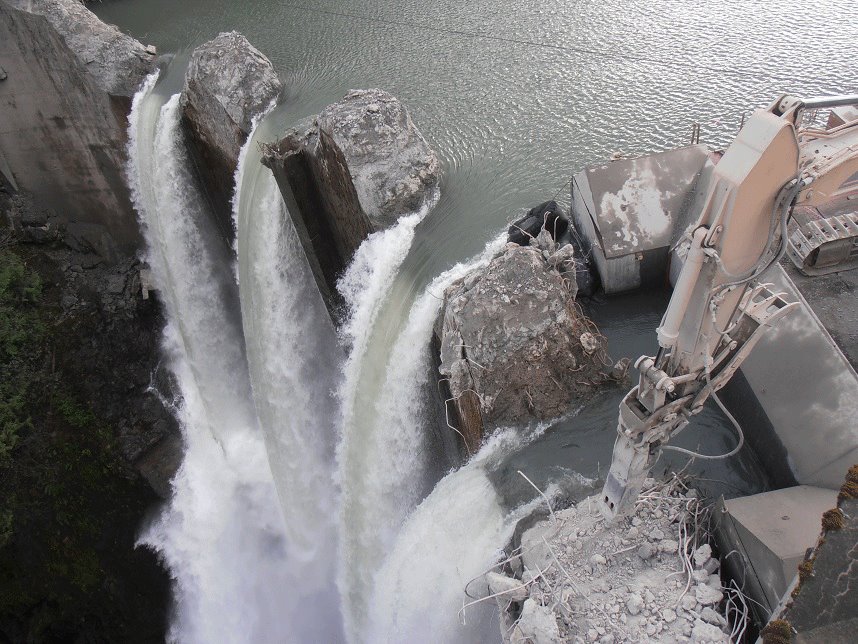
On Wednesday the nonprofit group American Rivers announced its list of outdated or unsafe U.S. dams removed in 2013 to restore rivers, tallying 51 projects undertaken by communities in 18 states working with nonprofit groups and state and federal agencies.

American Rivers says it had a hand in 25 of the 2013 dam removals, but tracks all removals, and is the only organization to do so. According to the group, the top states for dam removal last year were Pennsylvania (12), Oregon (eight), New Jersey (four), and, with three apiece, Maine, Massachusetts, North Carolina and Vermont.  About 1,150 dams have been removed since 1912, with most of those deconstructions occurring in the past 20 years.

Why remove dams? There are tens of thousands of them in the U.S., and quite a few are old, unsafe or no longer serve their intended purpose. As former U.S. Secretary of the Interior Bruce Babbitt once said, “on average, we have constructed one dam every day since the signing of the Declaration of Independence.” Removing them, especially those that no longer do enough for us (e.g., generating adequate amounts of reasonably clean hydropower), can restore river health, clean water, and fish and wildlife, and improve public safety and recreation. See a more complete list of reasons here.

To accompany the 2013 list, American Rivers launched an interactive map that includes all known dam removals in the United States as far back as 1936. The map features the name of the dam and river, location, year the dam was removed, and a description.

“For the first time ever, we have an interactive map that shows every dam removal that has ever happened in the U.S.,” said Devin Dotson, American Rivers’ associate director of communications. “There aren’t many things that have such a big impact on a river as a dam. They block a river, they can hurt clean water, they can hurt fish, they can hurt wildlife. American Rivers has pioneered a science-based approach to the removal of outdated dams.”

Read more from AmericanRivers.org:

51 dams removed to restore rivers in 2013

New interactive map: all known U.S. dam removals since 1936

Why we remove dams

Making hydropower safe for rivers

Leave a comment

Filed under Conservation, Dams and Hydropower, Environment, NGOs, North America, Rivers and Watersheds, Technology, Water Resources

First EU Citizens’ Initiative Calls for Right to Water and Sanitation

Image: Right2Water.eu

Image: Right2Water.eu

European Union law should guarantee the right to water and sanitation, the first valid EU citizens’ initiative has said. It also called for water services not to face liberalisation, collecting 1.8 million signatures after a campaign called Right2Water, which was backed by a string of NGOs and by the European Federation of Public Service Unions (EPSU). The activists held talks with the European Commission and MEPs on Monday in Brussels to mark the event. – Benjamin Fox, EUobserver

Read more:

Parliament kicks off debate on the legal right to water – EurActiv.com

Right2Water urges privatisation ban in first EU Citizens’ Initiative debate – European Parliament News

Interview: “Water is not a commodity, it is part of our heritage.” – European Parliament News

Right2Water website

Leave a comment

Filed under Europe, Human rights, Law, NGOs, United Nations, Water Resources, Water Shortage