It’s Long Past Time to Police Big Agriculture’s Water Waste

furrow_irrigation (1)

When you observe water-stressed and drought-stricken areas around the world, you hear the same question being asked again and again: Who uses the most water? A common assumption leads people to blame the general population for its wasteful ways, heedlessly watering their lawns and washing their cars despite a water shortage. But the real answer, in most cases, is agriculture — and not by a small measure. It often accounts for 70% to 80% of total water use, and sometimes more.

Irrigation and other water uses in agriculture, especially where it is a major industry for domestic and export food production, such as California’s Central Valley, make other water uses look like drops in a bucket. According to a 2012 study by the Pacific Institute, the Golden State’s 38 million people use just 4% of its water, while agriculture, including the raising of both crops and livestock, uses 93%.

The reason this matters so much is that Big Agriculture wastes epic amounts of water and often fights efficiency measures on the basis of cost. California, to stick with that example, uses much less drip irrigation than other arid farming regions of the world. Generally, efficiency standards and enforcement are not in place, which allows massive amounts of water to leak out of systems. And much of the water used simply evaporates because it is not recaptured. This goes on while agricultural users pump out deep aquifers’ groundwater far faster than it can be restored naturally, especially in times of drought.

The types of agriculture matter for the scale of water usage, as well. California rice growers flood the fields, whereas another crop might need only sips of water, relatively speaking. Beef producers use about 2,500 gallons of water per pound (as opposed to 100 gallons of water per pound of grain).  Although costly, relocating water-intensive agriculture from water-stressed regions to places where water is most abundant would make sense. In the U.S., that might mean moving some practices from the Southwest to the Southeast. In China, it would mean moving farms  from the arid north to the wet south. But in many countries, business and political interests would keep it from happening as long as possible, and in the end, severe water shortage and escalating costs would force the issue.

Where you have a massive industry, you have a wealthy lobby with a lot of political power to influence government spending. Critics of California’s $7.5 billion drought bond known as Proposition 1, to be voted on in statewide elections on Tuesday (4 November; update — it passed by a two-to-one margin), note that it provides for new dams and water-storage measures that will benefit agriculture. But it’s not yet clear what might be asked in return. About $50 million of the $7.5 billion appears to be earmarked for agricultural efficiency. Will future measures mandate adequate technology and standards of efficiency? Ultimately, the nine-member California Water Commission will decide how funds from the Prop. 1  bond measure, if passed, will be spent.  They should know that the industries using nine-tenths of the state’s water should be doing a lot more to help ease the region’s water crisis.

Read more:

UPDATE: California Propositions 1 and 2 Sail to Resounding VictoriesSan Jose Mercury News

Prop 1: Water Quality, Supply, and Infrastructure Improvement Act of 2014 – Ballotpedia

Prop. 1, a False Framing of California’s Water CrisisSanta Barbara Independent

New Report Provides Insight to California’s Proposition 1 – Pacific Institute

Prop. 1 Aims to Relieve Drought — But Not This One – Los Angeles Times

Cows, Rice Fields and Big Agriculture Consumes Well Over 90% of California’s Water – AlterNet

Report Targets Waste, Inefficiency in Agricultural Water UseLos Angeles Times


Leave a comment

Filed under Agriculture, Conservation, Dams and Hydropower, Drought, Groundwater, Law, North America, Sustainability, Water Resources, Water Shortage

The Water in Our Bodies Makes Us All Part Alien, Sort of

Image: Jonathan Knowles, Getty Images

Image: Jonathan Knowles, Getty Images

“A new study published today (Sept. 25) in the journal Science suggests that between 10 to 30 percent of the Earth’s water is older than the sun, and likely hails from comets born outside our solar system. That means that the human body, which is 60 percent water, contains a significant percentage of extraterrestrial aqua; in that sense, we are all part alien.”  – Douglas Main, Newsweek

And if it’s true of us, it’s probably true of others. Life elsewhere may take similar forms because water may form its basis, as it does ours.

Read more:

Much of Earth’s Water Is Older Than the Sun, and Came From Deep SpaceNewsweek

Up to Half of Earth’s Water Is Older Than the SunNew Scientist

Half of Earth’s Water Formed Before the Sun Was BornScience

Related posts:

Water Found in Stardust Could Mean a Universe Seeded With Life


Leave a comment

Filed under Groundwater, Oceans, Science, Space, Water Resources

California Finally Moves to (Eventually) Limit Groundwater Pumping

no-diving-from-bridge-008

Here’s a bulletin from the “isn’t-it-too-little-too-late?” department: Despite its history of drought, including the extreme dryness of the past three years, California has been the only state in the U.S. without a groundwater management plan — until now. This week Gov. Jerry Brown signed a package of legislation that will limit how much water can be pumped from underground aquifers … eventually. The changes will begin to take effect in the 2020s, and the last piece becomes active in 2040.

In a nutshell, Senate Bill 1168 directs local water districts to create sustainable groundwater management plans; Assembly Bill 1739 says state government will step in if local management falls short; and Senate Bill 1319 delays state oversight by several years, to appease farmers who complain that regulation will hurt their businesses. Agriculture is by far the biggest user of water, and no more so than in the Golden State, which grows and sells hundreds of crops under what some would call lax regulation.

Implementation of a plan is good news, though it seems too gradual a move for such a parched state. Because of the drought, the aquifers are depleting more quickly than usual, without “recharge” (a process that takes a lot of time and precipitation even in wet periods). Anything that gives nature more of a chance to catch up is a good thing.

Read more:

Amid Drought, New California Law Will Limit Groundwater Pumping for First TimeNational Geographic

California Drought 2014: Gov. Brown Signs Landmark Groundwater Regulations To Protect State’s Dwindling Water SuppliesInternational Business Times

California Drought Crisis 2014: Massive Groundwater Loss In US West Is Causing Earth’s Crust To Lift Like An ‘Uncoiled Spring’ – IBT

Brown Signs Bill to Regulate Pumping of Underground WaterLos Angeles Times

Drought-Plagued California Stops Treating Groundwater Like Private Property – BloombergBusinessweek

California Groundwater Problems and Prospects – California Water Blog

How Ground Water Occurs – USGS

Leave a comment

Filed under Agriculture, Conservation, Drought, Groundwater, Law

Set Heading for World Water Week in Stockholm

4951481766_c8dced02ba_z

In a couple of days I’ll join colleagues from WaterLex at one of the most prominent events in the world of water-related agencies, NGOs, services, and the like — World Water Week in Stockholm, which runs Aug. 31 – Sept. 5 in the Swedish capital, under the auspices of the Stockholm International Water Institute (SIWI). The theme this year, for this and other events around the world, is “energy and water,” two vital forces that are always interconnected.

WaterLex will exhibit in a booth shared with other organizations in the Swiss Water Partnership, and we’ll also put on a lunchtime side event on Monday, Sept. 1: Water & Energy Nexus: Smart Investments to Help Realize Human Rights. Co-convened with the UN Environment Programme (UNEP), the event’s panel discussion will explore how wastewater reuse for energy production can serve populations’ rights to adequate sanitation and a safe and healthy environment, while also making for a valuable investment in sustainability. Check out the speakers and topics. I’ll be the guy “moderating” (more like trying to keep up) or running around with a camera, taking photos for the press materials.

It will be my first time in Stockholm, so I hope to get around town a bit. A colleague recommended the Vasa Museum, the only preserved 17th century ship in the world. It heeled over and sank only minutes into its maiden voyage in 1628, and was raised in 1961. And of course there’s a museum dedicated to Abba.

Related posts:

WaterLex: A New Role for Me, Working on Water Law and Human Rights

If You Could Advise the UN on Water, What Would You Say?

WaterLex Helps Put the Human Right to Water Into New Legal Frameworks

Water’s Place Among Post-2015 Sustainable Development Goals

The Intersection of Environmental Issues and Human Rights


Leave a comment

Filed under Environment, Europe, Events, Human rights, Law, NGOs, Rivers and Watersheds, Sustainability, Technology, United Nations, Wastewater Treatment, Water Resources

Mapping the Spread of Drought Across the U.S.

Image: ClimateWizard.org

Image: ClimateWizard.org


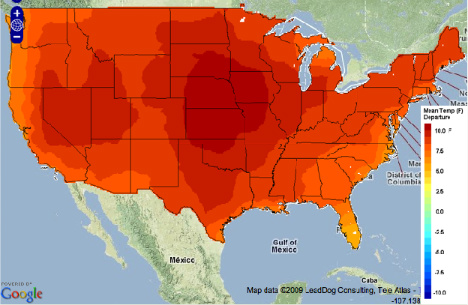
Slightly more than a third of the United States suffered moderate or worse drought as of July 22, and about 40% of the country has been abnormally dry in recent months, according to research cited in The New York Times. Climate change is intensifying drought and changing patterns. While the West dries out, especially California and southwestern states, more rain than usual has been falling east of the Mississippi River. Look at the mapping on NYT Interactive’s The UpShot.

Leave a comment

Filed under Climate Change, Drought, Environment, North America, Research, Water Resources

RIP Wanda Ellis Peters, 1938-2014

Visiting with Mom in Florida in April 2014, before her cancer entered the terminal phase.

Visiting with Mom in Florida in April 2014, before her cancer entered the terminal phase. She passed away just before midnight on Tuesday, July 15, 2014. She will be missed.

Wanda Ellis Peters, 75, of The Villages, Fla., passed away on July 15, 2014, at The Villages Hospice House, from cancer and related complications. She was born on Nov. 28, 1938, in Ferrum, Va., to Harry and Roosevelt (Gusler) Peters. She grew up on their farm with several brothers and sisters.

Peters graduated from Franklin County High School in Rocky Mount, Va., in 1956, and received a nursing degree four years later from Lewis Gale Hospital School of Nursing in Roanoke, Va. She married William D. Snow, of Brookline, Ma., and lived with him on St. Thomas, U.S. Virgin Islands, until they returned to the Boston area and had the first of their three sons in 1964.

Peters went on to raise three sons in the Hartford, Conn., area, where she worked as a registered nurse at Hartford Hospital. She earned a Bachelor of Science degree from Post College in 1985 and a Master of Science degree in business from Central Connecticut State University in 1991. Later, she lived in Cary, N.C., and worked as a nurse consultant inspecting nursing homes for the state.

She moved to The Villages, Fla., in 2006. In retirement she was an avid golfer and mahjong player, and enjoyed collecting fine jewelry and Norman Rockwell Limited Edition plates. She supported manatee preservation and was dedicated to several charitable causes through New Covenant United Methodist Church. Rev. Marilyn Arnell and members of the church spoke at a memorial reception for Peters, organized by her sons, on July 19 at Chatham Recreation Center in the The Villages.

Peters is survived by her three sons, Steven Snow, of Watertown, Mass., David Snow, of Geneva, Switzerland, and Scott Snow, of Framingham, Mass.; three sisters, Jean Morgan, of Stedman, N.C., Rita Wilkinson, of Roanoke, Va., and Yvonne Goldsmith, of Boca Raton, Fla.; two grandchildren, Miranda Snow and Jared Snow, of Framingham, Mass.; and many friends in The Villages and elsewhere.

She was preceded in death by her parents, Harry and Roosevelt Peters; her brothers, Neil, Delano and Joe; and one sister, Majella.

In lieu of flowers, memorial contributions may be made to Florida’s Save the Manatee Club or New Covenant United Methodist Church in The Villages. Arrangements by Hiers-Baxley Funeral Services.

Leave a comment

Filed under In Memoriam

China’s Virtual Water Flows: The Rich Get Richer, the Poor Get Thirstier

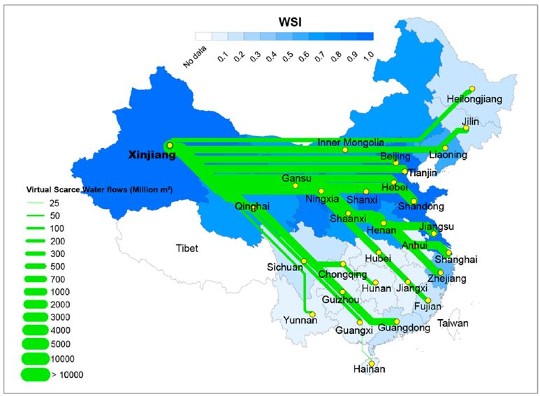
Virtual water flows in China. Copyright 2014 American Chemical Society.

New research shows that China’s wealthier and wetter southern provinces are draining already-scare water supplies from arid northern provinces, exacerbating shortages and increasing risk of crisis conditions.

The study, conducted by the International Institute for Applied Systems Analysis (IIASA) with the University of Maryland and published in the journal Environmental Science & Technology, uses the economic concept of “virtual water.” That refers to water tracked through trade of goods that require water to produce, as most do. The researchers say it is the first study to take water scarcity into account rather than treating all water as equal in the analysis.

The researchers say the study helps lay the groundwork for better water-resource management. One upshot is the idea that it might be smarter on the whole not to import water-intensive goods from the dry north to the wet south, even as the country gears up massive efforts to divert water in the other direction because of the shortages.

Read more:

The study: Virtual Scarce Water in ChinaEnvironmental Science & Technology

China’s arid north feeds water-rich south – Reuters

Following China’s water: a threat of scarcity – Nature World News

China’s hidden water footprint – Phys.org

Virtual water highlights China’s hidden water footprint – Science 2.0

Related posts:

 China Plans to Desalinate Vast Amounts of Sea Ice

China Raises Water Prices for Top Users

Mapping the World’s Most Water-Stressed Countries

Serious Water Conservation Demands Layered Approach and Emotional Commitment

Study: Freshwater Shortage Will Double Climate Change’s Impact on Agriculture


Leave a comment

Filed under Agriculture, Asia, Climate Change, Drought, Industry, Research, Rivers and Watersheds, Sustainability, Water Shortage

Oceans of Water Beneath Our Reach

Image: tomburke.co.uk

Image: tomburke.co.uk

A study published yesterday in the journal Science suggests oceans of water are locked in rock about 400 miles below Earth’s surface. It’s not liquid, ice or vapor, but rather hydrogen and oxygen embedded in the molecular structure of mineral rock. Researchers think it may help explain some things about how the planet formed, and how oceans gathered on the planet’s surface, which is great. But for many observers the first question is, how do we get at it? And the answer is a flat no, we don’t get anywhere near this stuff, much less turn it into a usable form, because it’s far too deep in the mantle. It’s 400 miles down, and the deepest humans have ever drilled is less than 10 miles.

Read more:

Dehydration melting at the top of the lower mantleScience

Water discovered deep beneath Earth’s surfaceUSA Today

New evidence of oceans of water deep in the Earth – Phys.Org

Oceans of water locked 400 miles inside Earth – Discovery News

Related posts:

Study Describes Vast Reserves of Water Under Ocean Floors

Leave a comment

Filed under Groundwater, Oceans, Research, Science, Water Resources

California Dreaming: New Study Pushes Massive Water-Conservation Effort

Image courtesy of Calif. Dept. of Water Resources

Image courtesy of Calif. Dept. of Water Resources

If California really tried, it could keep a reserve amounting to as much water all of its cities use in a year — about 14 million acre feet. That’s according to a new analysis conducted by the National Resources Defense Council (NRDC) and the Pacific Institute. It’s the “trying” that could prove difficult for the drought-ridden state, because it would take an aggressive, across-the-board effort to save water, reuse water, and capture lost stormwater. Widespread use of available but underused efficiency methods would have to be implemented in the state’s massive agricultural industry, which uses about 80% of allocated water, and throughout urban areas, which use about 20%. That will take strong political will, a lot of cooperation, and financial investment. But it’s worth it, because it will make a huge difference, and you can’t just keep throwing new plans for billion-dollar desalination plants at the problem.

Read more:

Issue Brief: The Untapped Potential of California’s Water Supply: Efficiency, Reuse, and Stormwater – NRDC and Pacific Institute

California Water Security Attainable, Study SuggestsThe Desert Sun

Related posts:

Past, Present and Future: California’s Epic Struggle With Water

Serious Water Conservation Requires Layered Approach and Emotional Commitment

California’s State-of-the-State Address: Brown’s Drought Plan in Broad Strokes

Civilization Lost? California’s 500-Year Drought Potential

To the Rescue in California? Solar-Powered Desalination

Over-Salted: The Trouble(s) With Desalination

Leave a comment

Filed under Climate Change, Conservation, Desalination, Drought, North America, Technology, Water Resources, Water Shortage

Are We in the Midst of the Next Mass Extinction?

The Sixth ExtinctionGet the antidepressants ready. I’m going above and beyond my normal reading about water crises and brushing up on the next mass extinction, which some scientists consider to be in progress at this very moment. My wife saw me eyeing Elizabeth Kolbert’s The Sixth Extinction: An Unnatural History in a Geneva bookshop this morning and bought it for me, despite knowing that I will probably blather on about it for weeks to come. Essentially, the theory is that another mass extinction, where most life on the planet goes the way of the dinosaurs (they were famously wiped out in the fifth and most recent mass extinction), is coming — and humans have greatly accelerated it by causing climate change. Looks like it’ll be a hoot! But seriously, hide the whiskey.

Leave a comment

Filed under Books, Climate Change, Extinction, Pollution, Research, Science