Category Archives: Climate Change

The News From Davos: Big Business Now ‘Cares’ About Climate Change

Image: Fabrice Coffrini/AFP/Getty

Image: Fabrice Coffrini/AFP/Getty

A chill runs through me whenever I hear a sample of the gaffe from Mitt Romney’s 2011 presidential campaign speech in Iowa: “Corporations are people, my friend.” He was responding to a heckler. What he said was accurate in the eyes of the law in the United States; a corporation has the legal status and rights of a person. But it’s not hard to imagine that Romney was cheerfully referring to psychopathic friends who would blithely step over your body to reach profit.

Corporations as psychopaths is not a new idea, of course. The 2003  Canadian documentary film “The Corporation” makes the case, in a clinical sense, that if corporations are people, they’re psychos. Put simply, they lack empathy for others. They focus on profit alone. The free market rewards such self-interested ruthlessness.

Judging by news from the World Economic Forum in Davos, Switzerland, public opinion and, more importantly, harsh economic reality, are pushing the corporate world to see that self-preservation now actually requires reactions to climate change. Many of today’s meetings of politicians, business leaders and reps from aid organizations in Davos, and a record number for the event overall, are about climate change and sustainable business practices. That’s a lot of talk from some influential people, and now that it’s about money as much as it is about doing good (or appearing to do so), maybe it will make a difference.

And, of course, as the mainstream media has well-recorded, the actor Matt Damon received an award in Davos for his work as co-founder, with Gary White, of Water.org, which works on access to freshwater for the world’s 800+ million who lack it. Damon is one of four recipients of the WEF’s Crystal Award, for artists who have contributed to a better world. The others are Peruvian opera star Juan Diego Flórez, American violinist and conductor Lorin Maazel, and the Iranian-born artist Shirin Neshat.

Read more:

Industry awakens to the threat of climate change – The New York Times

Davos 2014: live and archived blog coverageGuardian Sustainable Business

2014 World Economic Forum: live updates from Davos – The Huffington Post

World Economic Forum 2014 Meeting – WEF

Leave a comment

Filed under Awards and Honors, Climate Change, Conservation, Environment, Europe, Events, Industry, NGOs, Sustainability, Water Resources, Water Shortage

Calif. State of the State Address: Brown’s Drought Plan in Broad Strokes

Calif. Gov. Brown delivers 2014 State of the State Address. Photo Credit: Justin Short, Office of the Governor.

Calif. Gov. Brown delivers 2014 State of the State Address. Photo Credit: Justin Short, Office of the Governor.

Yesterday, the same day I wrote about California’s dire 3-year drought, California Gov. Edmund G. Brown Jr. laid out the state’s plan regarding the water shortage in his annual State of the State address to the California legislature. It’s not the governor’s job to provide exhaustive detail here, and he doesn’t. The drought got about 15 of the speech’s 130 lines.

Here’s the part of the address about the drought:

Among all our uncertainties, weather is one of the most basic. We can’t control it. We can only live with it, and now we have to live with a very serious drought of uncertain duration. 

Right now, it is imperative that we do everything possible to mitigate the effects of the drought. I have convened an Interagency Drought Task Force and declared a State of Emergency. We need everyone in every part of the state to conserve water. We need regulators to rebalance water rules and enable voluntary transfers of water and we must prepare for forest fires. As the State Water Action Plan lays out, water recycling, expanded storage and serious groundwater management must all be part of the mix. So too must be investments in safe drinking water, particularly in disadvantaged communities. We also need wetlands and watershed restoration and further progress on the Bay Delta Conservation Plan.

It is a tall order.

But it is what we must do to get through this drought and prepare for the next.

We do not know how much our current problem derives from the build-up of heat-trapping gasses, but we can take this drought as a stark warning of things to come. The United Nations Panel on Climate Change says – with 95 percent confidence – that human beings are changing our climate. This means more droughts and more extreme weather events, and, in California, more forest fires and less snow pack.

UPDATE: California drought prompts first-ever “zero water allocation” – Los Angeles Times

Related Posts:

Civilization Lost? California’s 500-Year Drought Potential (Jan. 22, 2014)

Leave a comment

Filed under Climate Change, Conservation, Drought, Environment, Events, North America, Water Resources, Water Shortage

Civilization Lost? California’s 500-Year Drought Potential

Image: NOAA

Image: NOAA

As a California resident for 18 years after college, I got to know dry weather pretty well. Right from the start, having arrived in the San Francisco Bay Area in the middle of the 1987  – 1992 drought, I came to see cloudless skies, brown grass and the occasional dryness-induced nosebleed as normal — so much so that the the incessant winter rains that returned years later seemed, briefly, to be freakish.

Now the state is in an even worse dry period — 2013 was the driest year since record-keeping began in the 1840s — and predictable doom-saying has ensued. It’s pretty hard to resist. After all, we know from the geological record that droughts in the area hundreds and thousands of years ago sometimes lasted decades, or even a century. Droughts of that magnitude have ended civilizations. See the Anasazi, wiped out in the Southwest about 800 years ago.

“Driest year since the 1840s” doesn’t sound good, but the reality is, indeed, probably worse. UC Berkeley paleoclimatologist B. Lynn Graham says old tree rings indicate the area hasn’t been so desiccated since 1580, 434 years ago. She points out that the past 150 years of modern development have been comparatively wetter years than some previous, longer, drier, and, arguably, “normal” periods, as noted above. Those long, dry periods could return.

An interesting characteristic of the drought is the proximate cause pointed out by meteorologists: a ridge of high pressure off the coast is “feeding off itself,” refusing to move or dissipate as it blocks wet weather from reaching land.  The timing is especially bad because California needs winter storms to replace its freshwater, in the form of rains and especially snow melt from the mountains. Sounds like an effect of climate change, something that’s easy to believe but hard to prove.

In addition to Herculean conservation efforts, what could be next for California if the drought persists? Greater Los Angeles and the San Francisco Bay Area are already projected to run out of water by 2050. Perhaps the state will pursue expensive seawater desalination projects on a massive scale, follow China’s lead on sea ice desalination, or go after fresh and brackish water recently found to be in aquifers under oceans.

Read more:

UPDATE: California drought prompts first-ever “zero water allocation” – Los Angeles Times

Why California’s water woes could be just beginning – University of California, Berkeley

California drought: Scientists puzzled by persistence of weather-blocking “ridge” – Christian Science Monitor

The worst drought in the history of California is happening right now – Right Side News

California drought: Water officials look to rules of the ’70s – SFGate

Gov. Brown declares California drought emergencySan Jose Mercury News

Leave a comment

Filed under Climate Change, Conservation, Desalination, Drought, North America, Sustainability, Water Shortage

WFES News: WorldBank Launches Initiative at Water and Energy Summits in Abu Dhabi

Image: World Bank Water

Image: World Bank Water

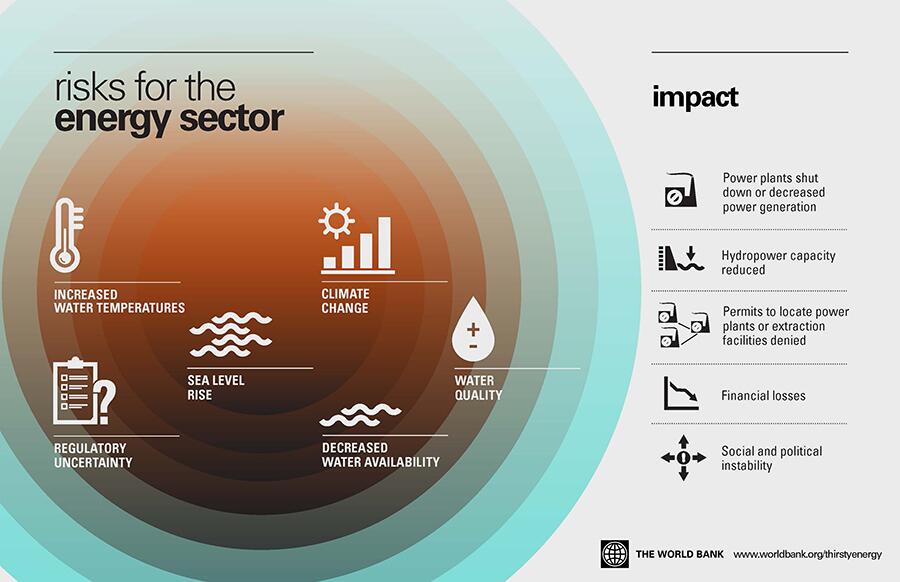
The World Bank has announced the launch of its “Thirsty Energy” initiative, aimed at helping governments tackle growing water-energy challenges, at the 7th annual World Future Energy Summit (WFES) and the 2nd annual International Water Summit (IWS). The two meetings are running concurrently, Jan. 20 – Jan. 22, at the Abu Dhabi National Exhibition Centre in the United Arab Emirates.

It takes a lot of water to generate power through various processes, and it takes a lot of power to extract, treat and deliver water. Yet, according to the World Bank, energy planning and development decisions are often made without regard to current and future water shortages. Its plan is to offer proactive, cross-sector advice on energy and water resource management planning, tailored according to a given country’s resources, modeling experience, and political and institutional realities.

Why go to all that trouble? Because near-future projections paint a disturbing picture. Today more than 780 million people don’t have enough access to potable drinking water, and about 1.3 billion lack electricity, according to estimates. In a world with a fixed and finite amount of freshwater but a surging population, global energy consumption is expected to swell 50% by 2035, while the energy sector’s use of water may increase by 85%. That means worsening water shortages, and, as noted in a previous post, climate change will make the situation even more dire in certain areas.

UPDATE: Thirsty energy: the conflict between demands for water and energyThe Guardian

More from WFES and IWS:

World Bank launches “Thirsty Energy” initiative – The World Bank / WFES

Will water contrain our energy future? (Thirsty Energy initiative, with extensive info graphics) – The World Bank

Four ways water shortages are harming energy production – The Water Blog (blogs.worldbank.org)

Denmark and Abu Dhabi sign clean-energy deal – The National

Related posts:

On tap Monday: Annual UN Water conference in Spain (Jan. 12, 2014)

Study: Freshwater shortage will double climate change’s impact on agriculture (Dec. 17, 2013)

Leave a comment

Filed under Climate Change, Conservation, Desalination, Environment, Events, Industry, Middle East, Research, Sustainability, Technology, Water Resources, Water Shortage

China Raises Water Prices for Top Users

Image: Houhai, Beijing, by D. Snow

Image: Houhai, Beijing, by D. Snow

In case you missed this Wall Street Journal report yesterday: “To Conserve Water, China Raises Prices for Top Users.”

It’s worth noting that China is merely raising its comparatively low water rates, and mainly for those who use the most water. It’s a new, three-tiered pricing structure, announced Friday, that is part of larger plan to restructure utility pricing nationwide. The water rates are considered low because they amount to 0.5% of disposable income. By comparison, Australia’s rates are 8.6%, Japan’s are 2.9%, the U.S.’s are 2.8%, and South Korea’s are 1.3%.

Note, also, that most people in China don’t drink tap water. They drink bottled water. I was amazed to be told of this and witness it when I visited Beijing and Yunnan Province in 2012. That’s more than a billion people filling landfills and that huge Pacific Ocean garbage patch with plastic. Experts say the new pricing structure is likely a precursor to upgraded drinking water standards in the country, which, with new investment in infrastructure, could be in place as soon as 2015, according to the WSJ report.

Leave a comment

Filed under Asia, Climate Change, Groundwater, Water Shortage

Study: Freshwater Shortage Will Double Climate Change’s Impact on Agriculture

Experts expect global warming to have a negative impact on crop yields, but shortages of water for irrigation could make for double the trouble, according to a study published yesterday.

As described in ScienceDaily, “given the present trajectory of greenhouse gas emissions, agricultural models estimate that climate change will directly reduce food production from maize, soybeans, wheat and rice by as much as 43 percent by the end of the 21st century. But hydrological models looking at the effect of warming climate on freshwater supplies project further agricultural losses, due to the reversion of 20 to 60 million hectares of currently irrigated fields back to rain-fed crops.”

The study’s lead author, Joshua Elliot, said the analysis is the first of its kind to feature an in-depth comparison of agricultural and hydrological models, which resulted in dramatically different results from other research.

“It’s a huge effect, and an effect that’s basically on the same order of magnitude as the direct effect of climate change,” Elliott, a research scientist with the Computation Institute’s Center for Robust Decision Making on Climate and Energy Policy (RDCEP), Argonne National Laboratory, is quoted as saying. “So the effect of limited irrigation availability in some regions could end up doubling the effect of climate change.”

The “good” news, if any, is that some areas will most likely see more precipitation, which could mitigate some of the effects of shortages, the study says.

The study, entitled “Constraints and potentials of future irrigation water availability on agricultural production under climate change” and conducted under the auspices of the Agricultural Model Intercomparison and Improvement Project, as part of the Inter-Sectoral Impacts Model Intercomparison Project, was published in Proceedings of the National Academy of Sciences.

Leave a comment

Filed under Agriculture, Climate Change, Environment, Research

Unchecked Emissions Will Drain Water Resources, Warns Leaked UN Report

Photo: MarkDhawn

Photo: MarkDhawn

The Hindu newspaper of India says that a United Nations report leaked online warns of dire consequences for freshwater resources if greenhouse gases remain unchecked.

The report is reportedly a final draft by the Working Group II of the UN Intergovernmental panel on climate change (IPCC), sent to all governments for comment before being finalized and released.

“In response to on-going climate change, terrestrial and marine species have shifted their ranges, seasonal activities, migration patterns, and abundance, have demonstrated altered species,” notes the report’s summary, adding that  developing countries, especially, are vulnerable to damaging climatic events (e.g., heat waves, droughts, floods and wildfires).

Regarding freshwater availability, the summary warns:

“Climate change will reduce renewable surface water and groundwater resources significantly in most dry subtropical regions, exacerbating competition for water among sectors. Each degree of warming is projected to decrease renewable water resources by at least 20% for an additional 7% of the global population.”

As the report notes, dried-up water sources will hurt crop yields even as demand surges with population growth.

Leave a comment

Filed under Climate Change, Environment, Research, United Nations, Water Shortage

Water, Water Everywhere: New Resources Updates

At the Waterline is still a new blog, with fresh information pages still being added. The Water Resources page doesn’t say “coming soon” anymore — it has actual resources! It’s a list, in alphabetical order, of agencies and media sources concerned with water issues. It’s a work in progress, so be sure to check on it from time to time.  Go there.

A Water Facts page is still, ahem, “coming soon.”

Leave a comment

Filed under Agriculture, Blog Changes and Updates, Climate Change, Environment, Groundwater, NGOs, Oceans, Research, Rivers and Watersheds, Sustainability, United Nations, Water Resources