Category Archives: Water Resources

Another Voice for Water in the Blogosphere

SIWI logo

Another water blog online means another hopeful drop in the bucket for a wet and fruitful future. The Stockholm International Water Institute (SIWI), one of the first organizations added to this blog’s Water Resources page, has launched a water blog that, in the word’s of SIWI’s executive director, Torgny Holmgren, is aimed at “sharing knowledge to realize a water wise world.”

In the blog’s “welcome” post, on Feb. 24, Holmgren said the fast-growing SIWI enables knowledge-sharing and networking among scientists, businesses, policy makers and civil society workers. As such, Holmgren wrote, the organization’s blog will “host opinions, commentary, photos and videos … as we deliver collaborative projects to solve water issues around the globe.” Read his post.

Leave a comment

Filed under Environment, Europe, Law, NGOs, Water Resources

Study: Americans Use Twice the Water They Think They Do

Image: treehugger.com

Image: treehugger.com

Americans use twice the amount of water they think they do, and appear to be particularly oblivious about how much H2O they flush down the toilet on a daily basis, according to new research. In a paper published online Monday in the journal PNAS, a researcher concluded that Americans underestimated their water use by a factor of 2, and were only slightly aware of how much water goes into growing the food they eat … ”
By Monte Morin, Los Angeles Times

Related pages: Water Facts, Water Resources

Leave a comment

Filed under Conservation, North America, Research, Water Resources, Water Shortage

Mapping the World’s Most Water-Stressed Countries

Image: thaibiodiversity.org

Image: thaibiodiversity.org

Playing with maps can be fun — except when it’s totally depressing.

In adding China Water Risk, an interesting information source, to this blog’s Water Resources page, I was reminded of another one I had already added: World Resources Institute (WRI), which provides a home for Aqueduct’s mapping surveys of water-stressed places. China Water Risk provides a version of WRI’s helpful breakdown of the data and list of 36 most water-stressed countries. So, rather than jumping straight into the mapping tool’s various menus to generate visualizations of data, you can get a bit of an overview of how the tool works and some of its findings.

Aqueduct’s mapping tool, the Aqueduct Water Risk Atlas, uses 12 indicators to value amounts of water stress, and assigns each country a score of up to 5 points, the high end of the scale for potential water stress. Sixteen countries representing a handful of world regions, such as the Caribbean, the Middle East, and parts of Africa and Asia, achieve a perfect(ly dire) score of 5.0. All 36 countries on the list of the most at risk of water stress rank 4.01 or higher, suffering “extremely high risk.” See the list.

Leave a comment

Filed under Africa, Asia, Caribbean, Conflicts, Middle East, Research, Sustainability, Water Resources, Water Shortage

Water Resources Spotlight: Green Growth Knowledge Platform

Image: piazzaffari.info

Image: piazzaffari.info

Last month the launch of the Green Growth Knowledge Platform (GGKP) coincided with the opening of the organization’s office at the International Environment House in Geneva, Switzerland, on Jan. 22. It was a stellar opportunity for me to get out of the house, but I missed it. So I doubled back and talked by phone with the group about its efforts.

What’s the point of GGKP? As Benjamin Simmons, the organization’s head. puts it in this succinct-yet-comprehensive overview: “Our aim is straightforward: to give policy makers, academics, experts and other professionals easy access to the most relevant green growth studies, policy analysis, guidance and data.”

It’s all about putting the best information about sustainable development and ways of reaching the goal of a “green economy” in front of the right people.  The link in the previous sentence goes to the UN Environment Programme (UNEP), which boils down the definition of green economy to its essence: It’s low carbon, resource efficient and socially inclusive. 

“The first part of our mission is about catalyzing research in and  around green growth,” said Amanda McKee, GGKP’s communications and outreach officer, based in Washington, D.C. “The second part of our mission is to make all the research acceptable to policy makers and practitioners.”

The data in the platform covers a lot of ground. The resource library contains about 600 publications organized by sector (e.g., water) and cross-cutting theme (e.g., gender), McKee said, adding that data is also organized geographically, representing 193 countries (see the Green Growth Map).

There’s also a collaborative element aimed at filling green-growth knowledge gaps. Currently, committees are looking at four topics: trade and competitiveness, technology and innovation, measurement and indicators, and fiscal instruments.  “If we’re able to generate results from this, we’ll branch out into other topics and launch new committees,” McKee said.

And how will GGKP know if it’s succeeding in its overall mission?

“We’re in the process of developing indicators for measuring success,” McKee said. “In terms of the knowledge-generation aspect, I think the way we’ll measure success is how much of this research is  ultimately picked up by these communities. On the knowledge-management side, a sign of success would be how many policy makers or government officials are making use of resources to put in place green-growth strategies or policies.”

The GGKP was established by the Global Green Growth Institute (GGGI), the Organisation for Economic Co-operation and Development (OECD), the United Nations Environment Programme (UNEP), and the World Bank, where it was initially “incubated,” McKee said. Those steering organizations provide in-kind contributions and part-time staffing to GGKP, while strategic funding comes from the government of Switzerland, which is providing 1.6 million CHF over three years.

GGKP’s main event is its annual conference; the next one, organized by UNEP, will take place in February 2015.  The group sometimes stages side-events at major conferences, like the “open-thinking event on the expansion of green-growth knowledge” planned for UNEP’s inaugural Partnership for Action on Green Economy (PAGE) conference coming up in Dubai, UAE, March 4-5, McKee said.

Leave a comment

Filed under Climate Change, Conservation, Environment, Europe, Events, Human rights, NGOs, Pollution, Research, Science, Technology, United Nations, Water Resources

Restoring Rivers: American Rivers Announces 51 Dam Removals in 2013, Builds New Interactive Map

dam removal

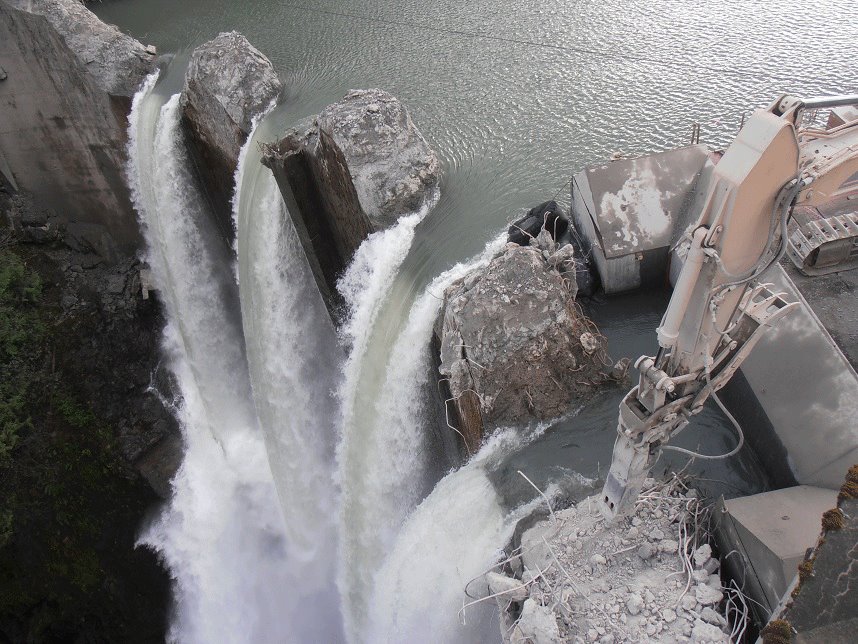
On Wednesday the nonprofit group American Rivers announced its list of outdated or unsafe U.S. dams removed in 2013 to restore rivers, tallying 51 projects undertaken by communities in 18 states working with nonprofit groups and state and federal agencies.

American Rivers says it had a hand in 25 of the 2013 dam removals, but tracks all removals, and is the only organization to do so. According to the group, the top states for dam removal last year were Pennsylvania (12), Oregon (eight), New Jersey (four), and, with three apiece, Maine, Massachusetts, North Carolina and Vermont.  About 1,150 dams have been removed since 1912, with most of those deconstructions occurring in the past 20 years.

Why remove dams? There are tens of thousands of them in the U.S., and quite a few are old, unsafe or no longer serve their intended purpose. As former U.S. Secretary of the Interior Bruce Babbitt once said, “on average, we have constructed one dam every day since the signing of the Declaration of Independence.” Removing them, especially those that no longer do enough for us (e.g., generating adequate amounts of reasonably clean hydropower), can restore river health, clean water, and fish and wildlife, and improve public safety and recreation. See a more complete list of reasons here.

To accompany the 2013 list, American Rivers launched an interactive map that includes all known dam removals in the United States as far back as 1936. The map features the name of the dam and river, location, year the dam was removed, and a description.

“For the first time ever, we have an interactive map that shows every dam removal that has ever happened in the U.S.,” said Devin Dotson, American Rivers’ associate director of communications. “There aren’t many things that have such a big impact on a river as a dam. They block a river, they can hurt clean water, they can hurt fish, they can hurt wildlife. American Rivers has pioneered a science-based approach to the removal of outdated dams.”

Read more from AmericanRivers.org:

51 dams removed to restore rivers in 2013

New interactive map: all known U.S. dam removals since 1936

Why we remove dams

Making hydropower safe for rivers

Leave a comment

Filed under Conservation, Dams and Hydropower, Environment, NGOs, North America, Rivers and Watersheds, Technology, Water Resources

First EU Citizens’ Initiative Calls for Right to Water and Sanitation

Image: Right2Water.eu

Image: Right2Water.eu

European Union law should guarantee the right to water and sanitation, the first valid EU citizens’ initiative has said. It also called for water services not to face liberalisation, collecting 1.8 million signatures after a campaign called Right2Water, which was backed by a string of NGOs and by the European Federation of Public Service Unions (EPSU). The activists held talks with the European Commission and MEPs on Monday in Brussels to mark the event. – Benjamin Fox, EUobserver

Read more:

Parliament kicks off debate on the legal right to water – EurActiv.com

Right2Water urges privatisation ban in first EU Citizens’ Initiative debate – European Parliament News

Interview: “Water is not a commodity, it is part of our heritage.” – European Parliament News

Right2Water website

Leave a comment

Filed under Europe, Human rights, Law, NGOs, United Nations, Water Resources, Water Shortage

As Fracking Booms, Wastewater Concerns Grow

Image: insurancequotes.org

Image: insurancequotes.org

With hydraulic fracturing for oil and gas continuing to proliferate across the U.S., scientists and environmental activists are raising questions about whether millions of gallons of contaminated drilling fluids could be threatening water supplies and human health.

– Yale Environment 360

Leave a comment

Filed under Fracking, Groundwater, Industry, North America, Pollution, Research, Rivers and Watersheds, Wastewater Treatment, Water Resources

New Desalination Method Disinfects the Water, Too

Image: IDA

Image: IDA

New Desalination technique also cleans and disinfects water: Electrodialysis has the potential to desalinate seawater quickly and cheaply but does not remove other contaminants such as dirt and bacteria. Now chemical engineers have worked out how to do that too. – MIT Technology Review

Leave a comment

Filed under Desalination, Oceans, Technology, Water Resources, Water Shortage

WaterLex Helps Put the Human Right to Water Into New Legal Frameworks

Image: WaterLex

Image courtesy of WaterLex

One of the benefits of living in Geneva, Switzerland, is that I have access to the United Nations and international organizations that work with it. WaterLex, for example, is an international NGO that partners with UN Water. It takes an interesting, forward-looking, “lawyerly” approach to working on issues related to freshwater scarcity. The group, with a staff of seven based here, helps water-governance stakeholders in various countries establish policies and standards that comply with the human right to water and sanitation (HRWS). To do its work, the staff consults with more than 100 international experts in water management, development and law.

Many water NGOs work on access to water, helping people in water-stressed communities survive by delivering clean water, digging wells, installing pumps, and so forth. WaterLex attacks the problem close to its root and in a way that helps enable water security for future generations: It trains lawmakers and others with influence over water resources in a community, or a country, on how to implement new legal frameworks in which the human right to water is central.

WaterLex Executive Director Jean-Benoit Charrin co-founded the organization in 2010, the same year the human right to water and sanitation became fully recognized. I spoke with him on Tuesday at the WaterLex offices down the street from the Palace of Nations (UN). The rest of the staff, a mix of lawyers and operations experts, were away on missions. Although I would have liked to meet them, I’m glad they were off doing their work.

“There are four things we never want to hear people say again,” Charrin said. “That they didn’t know there was a problem. That they know there is a problem, but they don’t know how to deal with it. That they know there is a problem and how to deal with it, but they don’t know how to get the money. And finally, that they know there is a problem but they don’t care.” He paralleled the four statements succinctly with four WaterLex work areas:  providing assistance with information, capacity-building, budgeting, and accountability. Learn more about the group’s work below.

WaterLex tools (naturally, these are also on the Water Resources page):

WaterLex Legal Database on the Human Right to Water and Sanitation

WaterLex Toolkit: Integrating the Human Right to Water and Sanitation in Development Practice

Examples of WaterLex activities:

  • Worked with 10 universities to develop its online Legal Database (link above), a reference tool for policy makers that enables them to harmonize their legal frameworks with HRWS.
  • Trained more than 40 members of the Pan African Parliament on the integration of national legal frameworks with HRWS.
  • Partnered with the UN Development Programme (UNDP) to advise the government of Niger on designing a decentralized cooperation strategy that complies with human rights obligations.
  • Drafted a resolution adopted by the African Commission on Human and People’s Rights clarifying legal responsibilities of states in the management of water as a result of human rights commitments.
  • Worked with the Swiss Agency for Development Cooperation (SDC) to develop a toolkit and field training for water program managers in Nicaragua, Moldova and Mozambique.
  • Assisted the UN Economic Commission for Europe (UNECE) in the design of an Equity Score Card to help governments assess their population’s relative access to safe and affordable drinking water.

Leave a comment

Filed under Africa, Conservation, Drought, Europe, Groundwater, Human rights, Law, NGOs, Pollution, Research, Rivers and Watersheds, South America, United Nations, Water Resources, Water Shortage

Over-Salted: The Trouble(s) With Desalination

Image: Sierra Club, Angeles Chapter

Image: Sierra Club, Angeles Chapter

It’s tempting to see desalination as an eventual cure-all for parched places like California — something that is expensive to implement and run because of energy costs, but worth prioritizing someday. Someday, that is, when there is no other way to get enough freshwater. Many countries have turned to it.  Unfortunately, cost is not the only reason to put off desalination projects. Their byproducts, or waste, are bad for the environment and difficult to deal with safely. And in California, critics of seawater desalination would add that far more should be done through conservation before turning to drastic measures.

I recently wrote about solar-powered desalination as an alternative to traditional methods that might help California with its record-breaking drought, focusing on WaterFX and its solar distillation of agricultural run-off water for re-use. On Tuesday, The Guardian‘s Oliver Balch picked up on the story in some depth, referring to renewable desalination projects all over the world, but focusing on WaterFX. That prompted a thoughtful article by environmental journalist Chris Clarke for Southern California’s KCET.org. He asked an obvious and very important question: What about all the salt and other stuff we take out of the water?

At the end of any kind of desalination process, you get leftover piles of salt and buckets of super-salty brine. (Use any measurement metaphor you like, appropriate to scale: piles and buckets; hills and lakes; mountains and oceans.) You get a little freshwater and a lot of leftover crap, some potentially useful and some not, and there’s only so much you can do with it. With WaterFX’s solar distillation, you get brine laced with chemicals and solids from the soil, from fertilizers, motor oil and other sources. The company says it can sell the byproducts, but there’s room for skepticism (and leaky landfills standing by). With seawater, desalination projects tend to filter brine back into the ocean, where it dissolves over time. But brine waste, heavier than seawater, can smother sea life on the ocean floor. And, looking ahead, if huge coastal desalination projects continue to spring up all over the world, how much additional salinity can sea life tolerate? Even in the oceans, a little too much salt can kill.

One thing is relatively clear: Powering desalination with renewable energy should bring down long-term energy costs while providing freshwater. But questions and problems remain. In addition to pollution worries, the timing of when to make the big investment can be tricky. As Clarke points out, a large desalination plant opened in Santa Barbara, Calif., in 1992 because of a drought. But the drought ended, and the plant just sat there because it was too expensive to run in the absence of a crippling water shortage. After its test runs, it never produced a drop of potable water. Now, the largest  desalination plant in the western hemisphere is slated for 2016 completion in Carlsbad, near San Diego, at a cost of $1 billion.

Read more:

UPDATE: Desalination could help California — but only if it’s done right – Los Angeles Times

UPDATE: California drought prompts first-ever “zero water allocation” – Los Angeles Times

In talk of solar desalination, there’s a salty elephant in the room – KCET.org

Is solar-powered desalination the answer to water independence in California?The Guardian

California identifies 17 communities that could run dry within 100 days – CA.org

Carlsbad desalination plant construction on track to meet 2016 goal – KPBS San Diego

Related posts:

California’s State-of-the-State Address: Brown’s Drought Plan in Broad Strokes

Civilization Lost? California’s 500-Year Drought Potential

To the Rescue in California? Solar-Powered Desalination

1 Comment

Filed under Agriculture, Conservation, Desalination, Drought, Environment, Industry, North America, Oceans, Pollution, Technology, Wastewater Treatment, Water Resources, Water Shortage